The Chilean national park Torres del Paine was place number one in Patagonia which we had been dreaming of seeing, so we set off for a journey to the park from El Calafate. Before leaving El Chalten we had been thinking of cycling to Torres del Paine, but after three days in the pampa we had realized that we had more than enough of struggles and we were really not disposed to continue fighting with the winds. The town from where trips to Torres del Paine start is called Puerto Natales. We went there in an ordinary and unexciting way – by bus. We had left our bicycles and other camping stuff in the hostel, because we were planning to come back to El Calafate.
We never felt that we had made an incorrect decision afterwards. All the way from El Calafate to Puerto Natales there is the inevitable irksome steppe with bushy grass and no water. Nothing to see at all. The wind was as strong as before, we could feel it by the way it was shaking the bus, which was not surprising because for the most part it was either blowing from the side or to the front.
Puerto Natales too is exposed to all sorts of winds, while we were walking from the bus station to the centre of the town, we were afraid that our bags might fly away. The unpretentiosly looking town made a nice impression nonetheless. After starting looking for accommodation we were surprised at how expensive everything was – but why wonder, if the park is famous around the world? We ended up staying in a room at a guesthouse that belonged to an old woman whose name was Ana. We called her “Babushka Anya” lovingly. She served us breakfast, brought apples to the room for us and was persistent in her attempts at having a small talk in Spanish to us, which my limited vocabulary made a bit of a struggle. The guesthouse left much to be desired, the room was run-down and very cold, we had to sleep under three blankets, but after the trip we felt reluctant to look for a better place, and after spending one night there we got attached to Babushka Anya and decided to stay. Also it was not that important because we were about to leave for a 5 days’ trek to Torres del Paine anyway.
it takes a couple of hours, or slightly more, by bus from Puerto Natales to the park. We bought the tickets in advance, and rented a big backpack, because we only had a small backpack and cycling bags, and in the park we would have to walk and carry our stuff on our backs.
On the day of departure we loaded our backpacks to the top, I could hardly walk with mine and was unable to fathom how we could walk with these piles of stuff for 5 or 6 days.
Our first attempt to leave for the park failed, when we came to the bus station we were told that buses weren’t going to the park today because of the wind, it would be too dangerous for people. We had to return to Ana’s guesthouse. We finally were able to go in a day or two.
To my knowledge, there are two itineraries in the park: the so-called W-trek, and a circle trek. The first one is the most popular, it is shorter than the circle one and you can see the main beautiful sights. More experienced hikers go to the circle one. Not being so experienced we chose W-trek.
W trek is called this way because it is shaped like letter W.
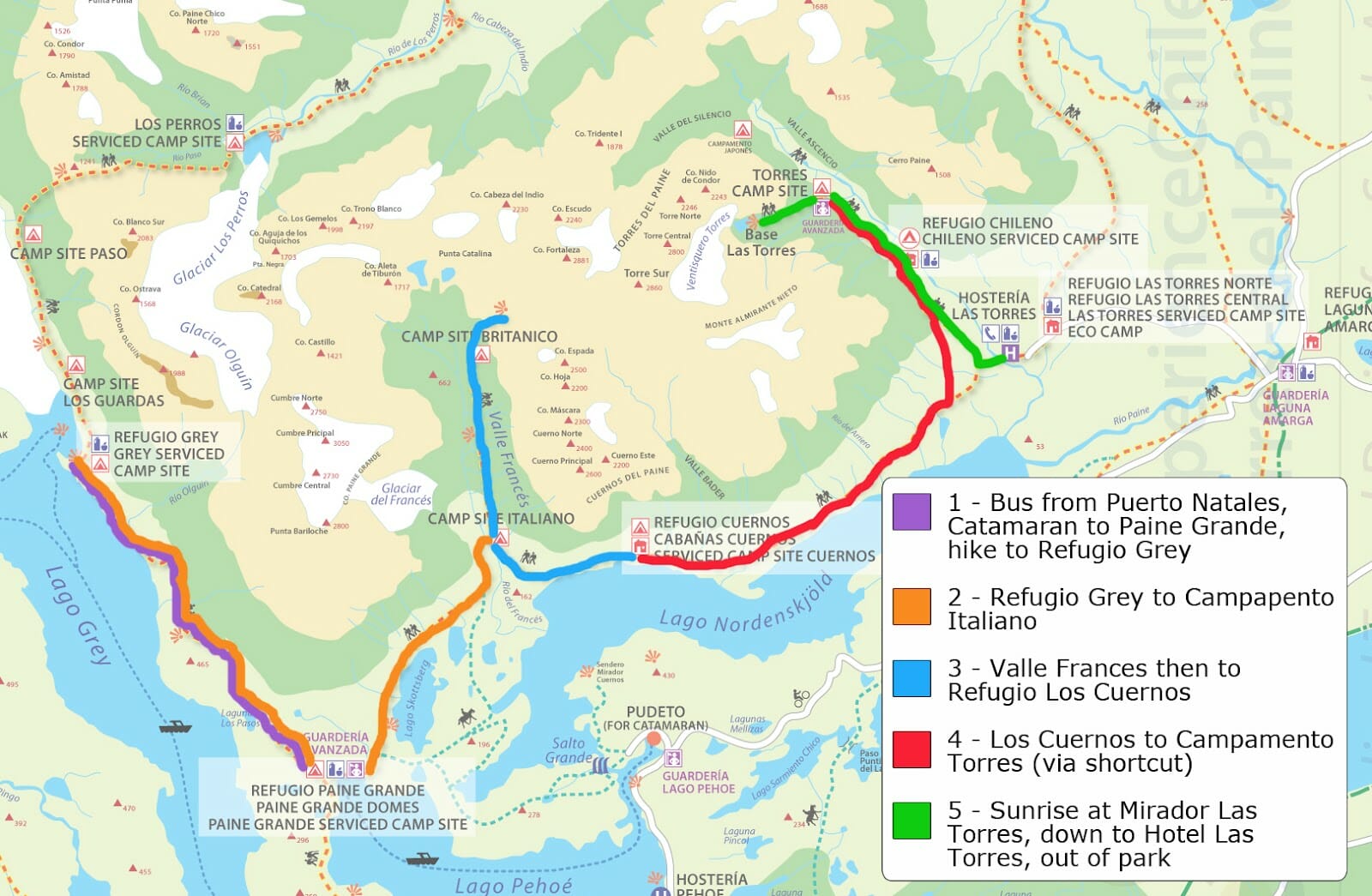
W trek is considered to be walkable in 5 days. We walked for 5 days but we managed to walk “an abridged” W letter only, with the short middle stick and without the left stick at all. So in the end it didn’t look like W for us at all.
As for accommodation in the park, one can either stay at campsites or in hostels (“refugio” would be the right word in Spanish which means “refuge”). Refugios cost some extortionate money and therefore we didn’t even give it a single thought. Campsites can be paid or free. It is possible to rent a tent and some other stuff at campsites (I am not sure whether only at paid ones or at all of them). In order to curb our expenses we decided to carry the tent ourselves, and it was our mistake.
A lot of people post their opinions on the net about what the best way of walking W trek is: from west to east or vice versa, and at what time of the day to climb to Torres Lagoon. I won’t go into much detail here, I will just mention that we ended up walking from east to west, from the right stick of W to the left.
After arriving, we spent the first night at the paid camping Las Torres, it’s a beautiful place at the foot of the mountains, with a lot of trees and grass, all in all a great site for camping. We had read about hordes of mice in the park and about the necessity of hiding food from them by way of hanging it on trees. We had prepared well, we had a rope and we put food into the backpack, wrapped the backpack in a raincoat just in case and hung it on a tree. I don’t think I saw anyone who bothered to do the same. We didn’t see a single mouse in the park, so we must have been lucky.
On day 1 the plan was to walk the right “stick” of W – on the top of it there is the famous Torres lagoon; to spend some time taking in the view and go back the same way. In this manner we could leave our things in the camping and walk light handed. The drawback of this part of the trek is that it is a climb almost along the whole length of it which is 9 kms, and it culminates in a steep ascent to Torres lagoon (one or two kilometres of a nearly vertical way up). When you are already tired after having walked difficult 9 kilometres, the hardest bit is still ahead. And after that the way back is still awaiting you. Thankfully, it’s all the way down now (however it’s not a piece of cake to walk down a steep descent either). We had done something like that in El Chalten area (see our previous post about El Chalten) when we climbed to Lagoon de los Tres, with one thing being different that the climb was intermittent, with many flat bits. In the case with this trek in Torres the first 2-3 kilometres are a very steep and constant ascent, and then there are some slight descents followed by more ascents until you reach the last and the hardest climb.
Some people walk this part of the way with their luggage and spend the night at a campsite which is located right next to the start of the final steep climb. This campsite is free and it has to be booked in advance because there are too many people who want to stay there. This method gives you one advantage – you can wake up in the morning when it is still dark, walk up to the lagoon and watch the sun rise and illuminate the summits with scarlet red. They say the sight is out of this world.
We had decided to walk this route in one day, without our luggage, and were very glad that we had decided so, because this part of the way proved to be the hardest. It’s hard enough to walk light-handed. Surprisingly, we met some elderly people looking well over 70. They walked slowly but steadily. What can you say – well done!
As to the surrounding landscapes, then it is undoubtedly very beautiful there. A part of the way goes high along the mountain slope, with a stream babbling far below. The path follows the slope down to the stream and then enters a forest and climbs up the slope again. Then after a while you walk out of the forest right in front of the path to Torres lagoon – which is less of a path and more of a steep and stony mountainside. Frankly speaking, I didn’t believe I would make it. Eventually we did it. It took us not less than two hours.
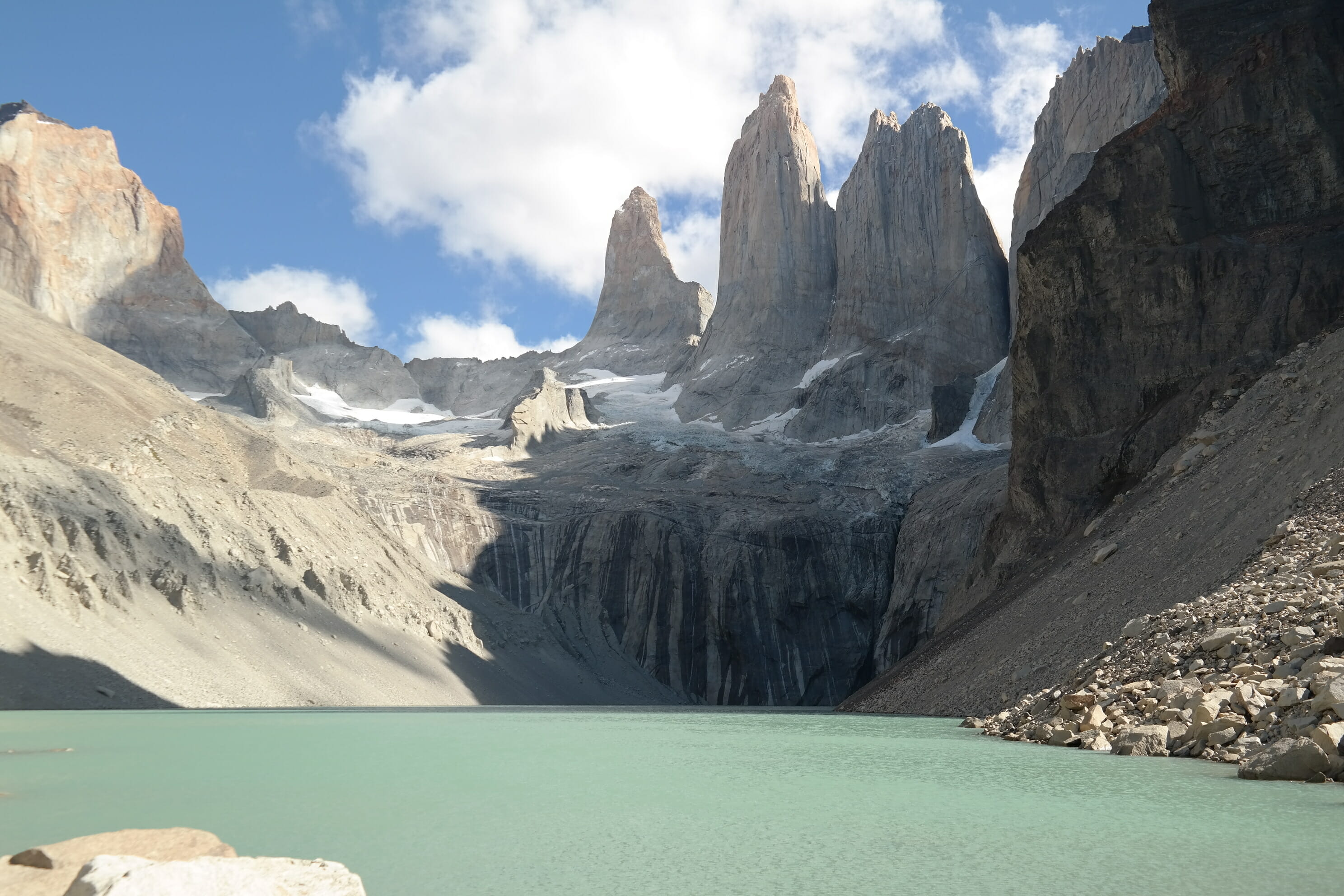
People normally use the most exalted words for description of the lagoon. And undoubtedly, the lagoon is amazing. But we were not as impressed as we had expected to be, most likely because our expectations had been set too high. We also made a mistake by putting Torres del Paine to the end of our Patagonian trip. We had seen so much by this time that our ability to perceive beauty had become a bit blunt. The surrounding landscapes became rather ordinary to us, as we had got used to them. No wonder – it was our third month on the road. Also we had just visited Lagoon de los Tres in the Fitzroy area and we had given our hearts to that lagoon. It had struck our imagination – with its extraordinary emerald colour and odd shapes of the surrounding mountains. Torres Lagoon got the second place in our personal rating.
On the way back, when we were conquering the last three kilometres of the steep descent, my legs started failing me. When we finally reached the campsite, I literally fell on the ground and lay there for a long time. Igor was exhausted too but at least he was able to move.
I didn’t believe then that we’d be able to walk the next day. Tomorrow we would be supposed to continue our way with all our luggage. The only thing that encouraged us was that tomorrow we wouldn’t have to climb all the time and that we would have to walk “just” 11 kilometres.
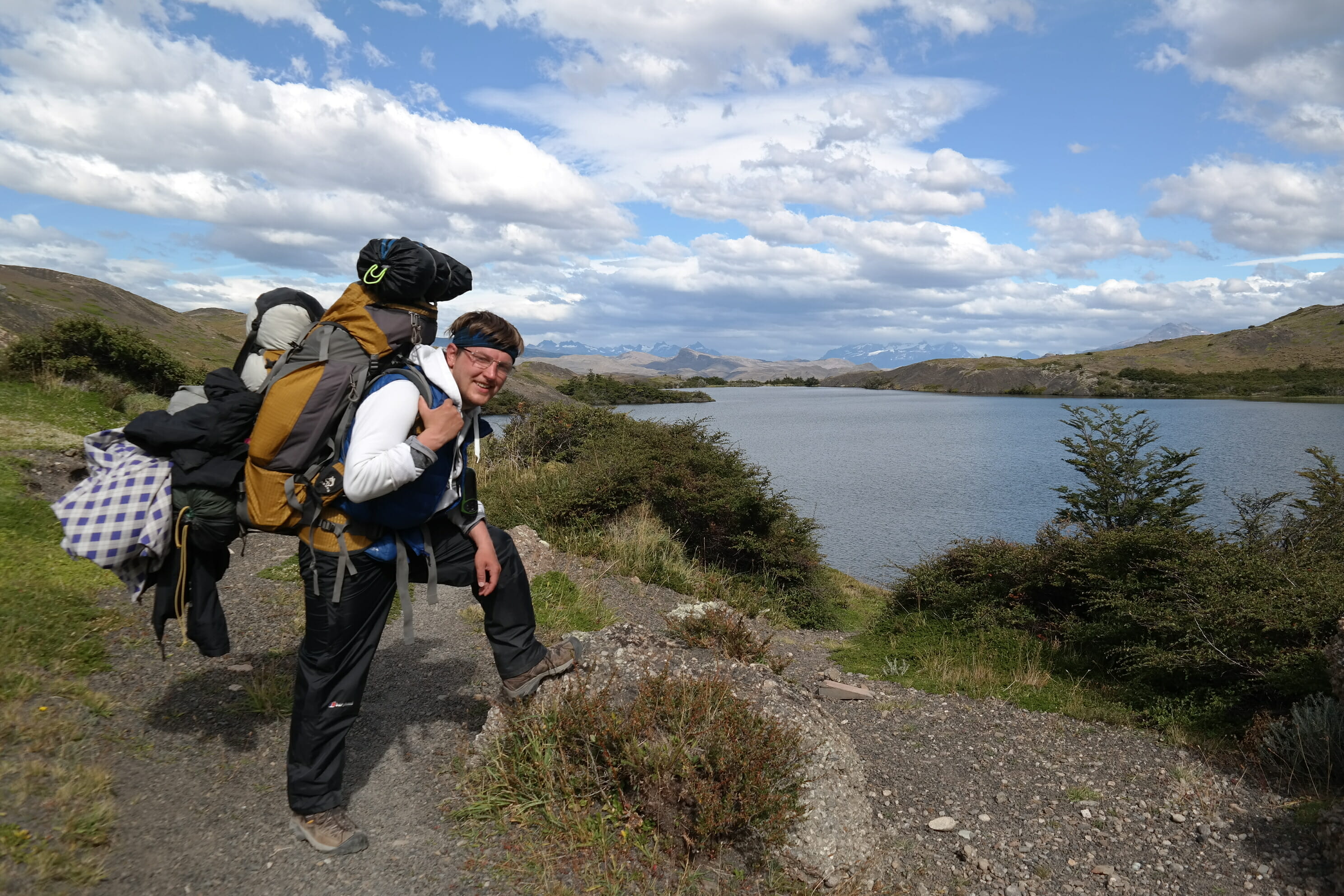 Next day in the morning we loaded ourselves with our luggage. I only managed to carry one small backpack which was still quite heavy but it was nothing compared to Igor’s who was carrying a whole pile of stuff: our tent, sleeping bags, mats and the rest. This is how it looked:
We began our way quite cheerfully. The path was going through the field along the mountains, there were no big climbs which made our walk a breeze. There were vast swathes of grass around with horses grazing on them. After a few kilometres we reached a very beautiful turquoise lake.
It was scary to look at Igor’s backpack, still Igor didn’t complain, for him it was even something to joke 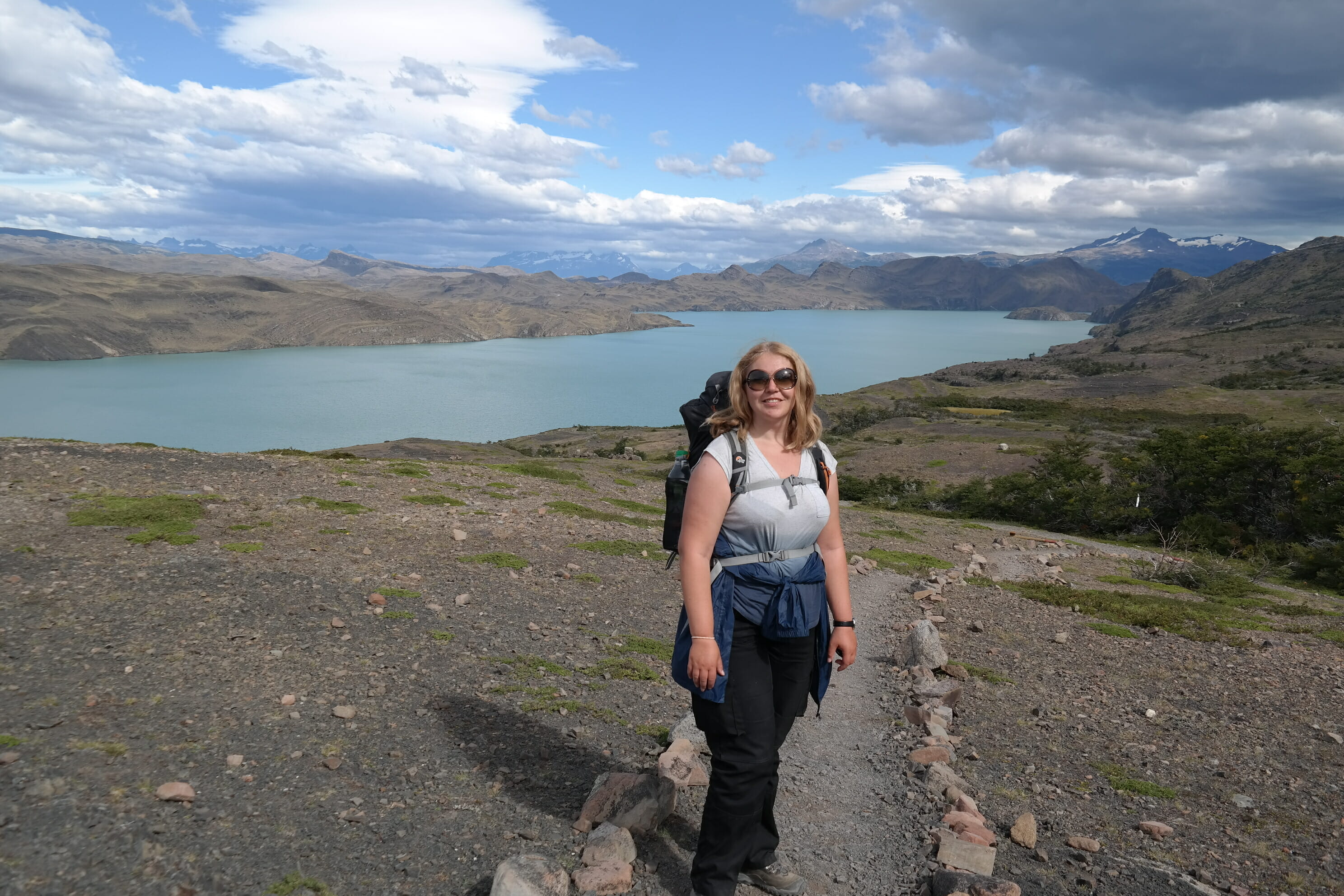 about. From time to time we met people with huge backpacks similar to his, and they were nearly running which surprised us a lot. Later we found out that there was some competition in the park. It amazed us how they jumped from stone to stone when they looked like snails with their whole house behind their backs.
It was really pleasant to walk along the lake, the view from the height was splendid. The sound of rumbling glaciers was especially striking. From time to time in the midst of silence and under clear skies we heard a sound which resembled thunder or distant explosion which emphasised the grandeur of the surrounding mountains.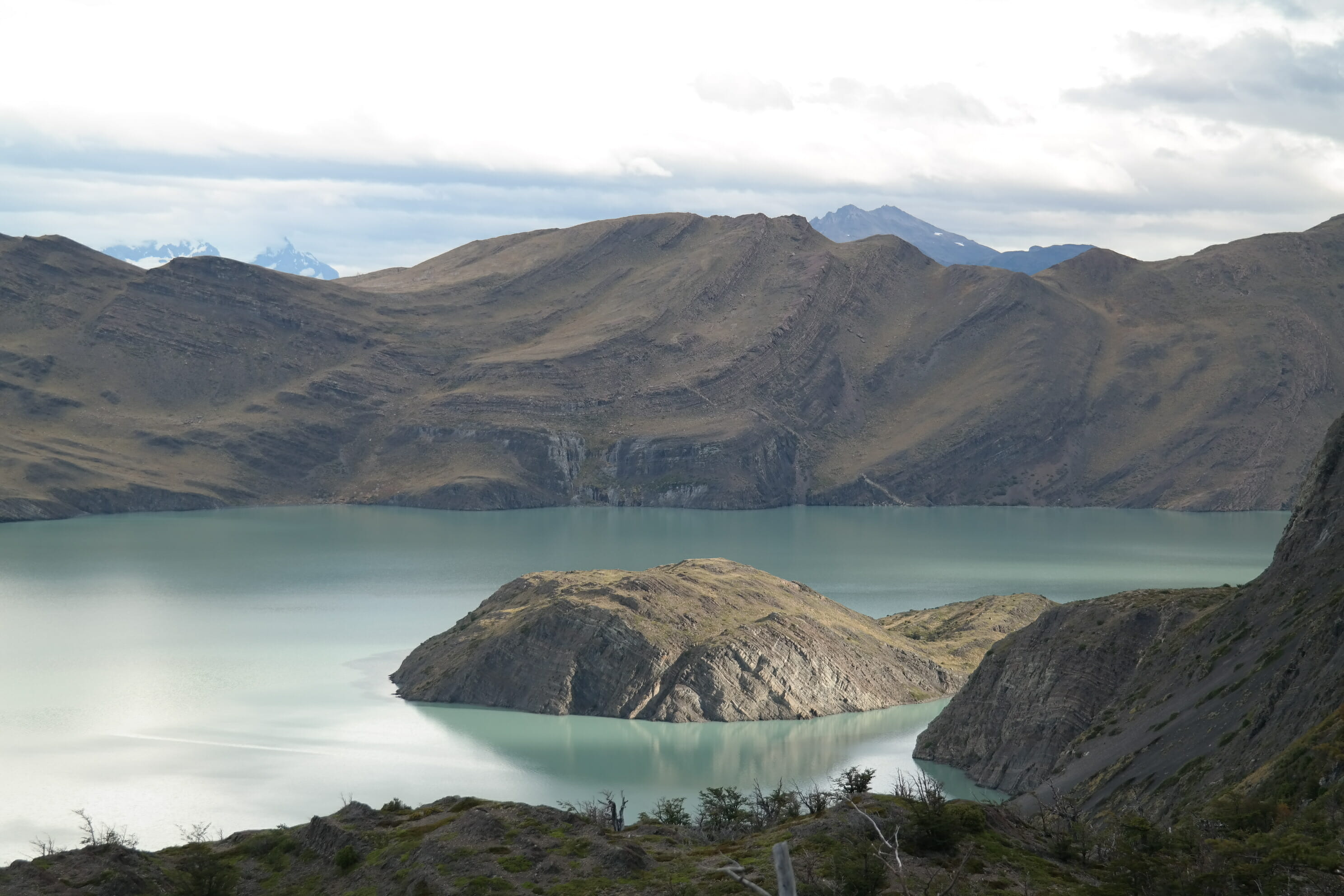
After a while we started to feel tiredness, our legs began to lose strength. For Igor, it became difficult to walk down slopes, as the heavy backpack was trying to pull him down. We walked about two thirds of our way when we started giving out. We no longer could react to the surrounding beauty, although I paused from time to time to take a picture of an especially spectacular view.
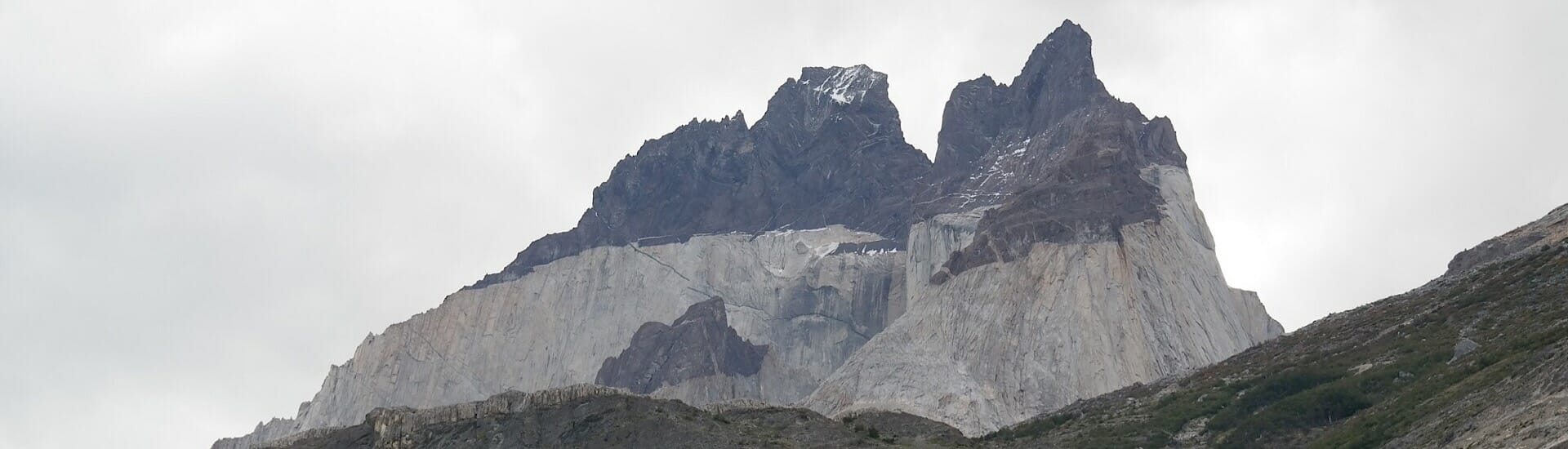
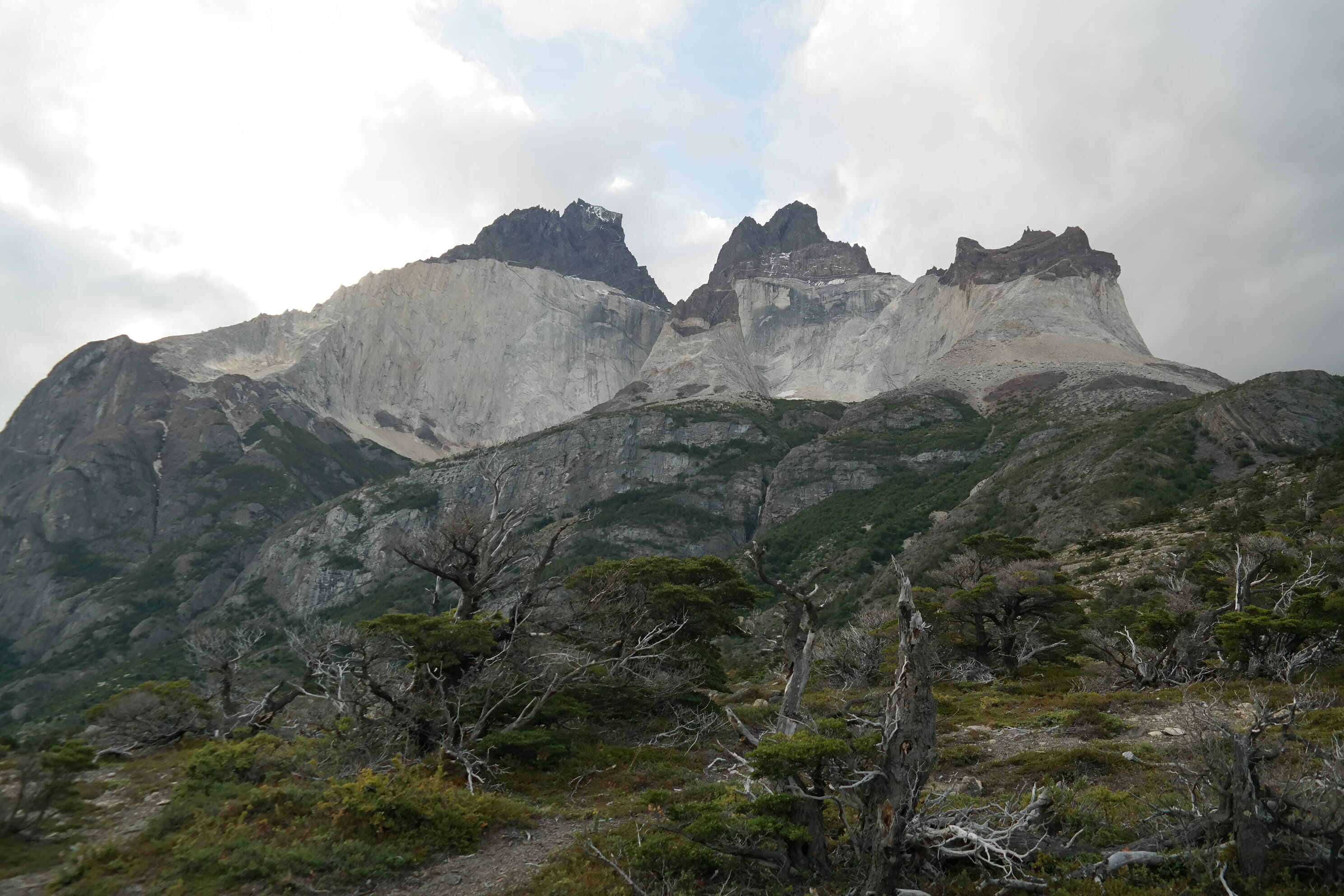
The path became stony which made walking a struggle. It went along the slopes of the hills along the lake, up and down, and walking down became quite scary, especially for Igor with his huge backpack. We couldn’t wait for the camping to appear. When we finally spotted it, it looked like there were 2 more kilometres to go which sounded like ten to us. Straining every sinew we finally dragged our feet to the campsite which was called Los Cuernos. The camping is located in a very picturesque place, right at the foot of the mountains called Los Cuernos which translates as “The Horns”. These are two grey mountains with brown tops, which to me looked more like two giant cakes.
There are no flat surfaces at this campsite, so most of tents are set on wooden platforms. We set up a tent and then went to look for the place to check in and pay but couldn’t find anyone. Nobody turned up until the next morning. This camping was very crowded, there was also a refugio nearby. In the kitchen it was difficult to find seats at the tables and to find a place to put your stove to cook food. I don’t like places like this, but there was no choice. In the morning we chatted to a guy who came to Torres del Paine for the second time, because after his first trip he had his camera stolen, with all the pictures from the park. So he went to take all those pictures again. Isn’t it amazing? The park is indeed worthy of the effort of coming back.
Today was going to be easy. We had planned to walk only 5.5 kilometres to the next camping called Italiano which is located at the beginning of the middle stick of W. This camping is free. We had planned to spend 2 nights there and in between to walk the middle stick without the luggage. The path to this camping was really the easiest of all, but at the end we got caught in the rain. As we were getting closer to the camping the weather was noticeably changing. When we nearly arrived, we saw a mountain with a huge glacier, and the path turned right there. Camping Italiano lay in the vicinity of the glacier. There was a different microclimate there. It became much colder and it was constantly drizzling. I was apprehensive that we might not find a free spot at this camping as it was free of charge, but we found a good pitch at some distance from the reception, closer to the forest. We were told by the staff that we could only spend one night here. However in practice nobody checked on us.
“Italiano” camping was very simple, without a shower or even a sink, there was no shop either.
As soon as we came, we set up a tent. I made a mistake of not having changed right away and was hanging around in wet clothes for a while. It’s very hard to convey the extent to which I started to feel cold because of this. When I got inside the tent, put on all my dry clothes, a jacket, a hat and got inside a sleeping bag and covered myself with the second one, I still couldn’t warm myself up. It felt like cold emanated from each cell of my body. It was plain awful. I can’t thank Igor enough for being so caring and cooking the tastiest pasta in my life which helped me to warm up a bit. We also had special inserts for gloves and shoes which start emitting warmth after opening them due to some chemical reaction. We had carried them with us for three months thinking we would never make use of them – and now I put them round myself and finally warmed myself.
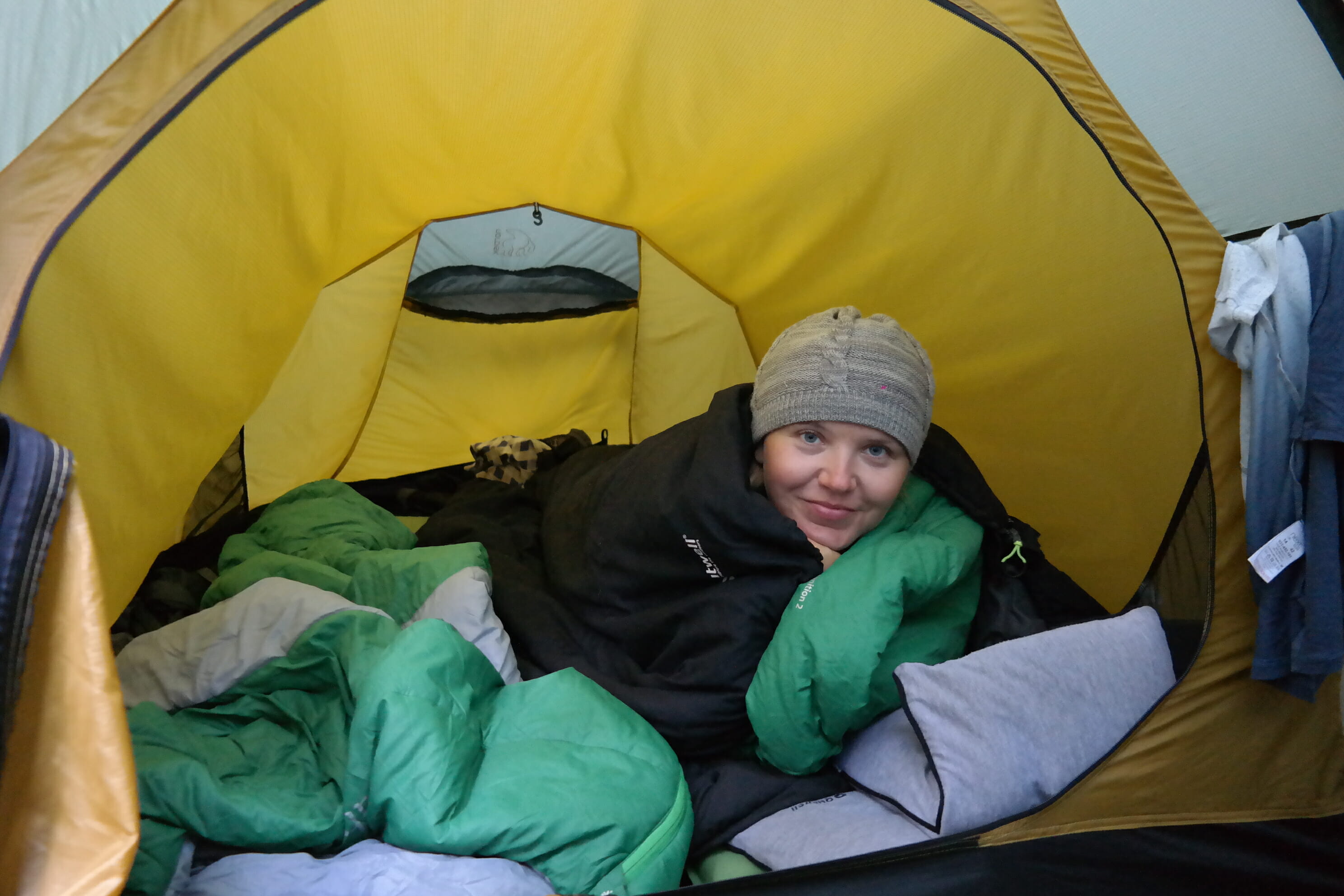 This evening was a turning point for us. Sometimes you endure hardships because you have motivation and understanding why you want to do this, and this motivation makes the hardships easier. On that evening I realized that my motivation had run dry and I didn’t want to walk anymore, didn’t want to freeze and generally was feeling tired. What I wanted was to have rest in a warm and dry place. Unfortunately, this realization dawned on me right in the middle of our trek. I shared this with Igor and he agreed with me. He said that we had walked enough, and if we were no longer enjoying it, there was no reason to force ourselves. Then we decided that we wouldn’t finish the W trek. Instead we decided to walk to Refugio Paine Grande (7.5 kilometres more). We wouldn’t walk the last stick of W – from Regufio Paine Grande to Glacier Grey (11 kilometres one way, 22 kilometres return).
The next day proved to me that we had taken the right decision.
In the morning of the next day we started to walk on the middle stick. Our idea was to get to Mirador Britanico which was 7.5 kilometres away, and to get back on the same day. We left our things in the tent and walked light handed. It was rather cold and windy. The path was challenging right from the start: we had to climb boulders up the hill. After 2 or 3 kilometres we reached the first viewpoint – mirador – from where we saw a stunning view over the lake and the glacier.
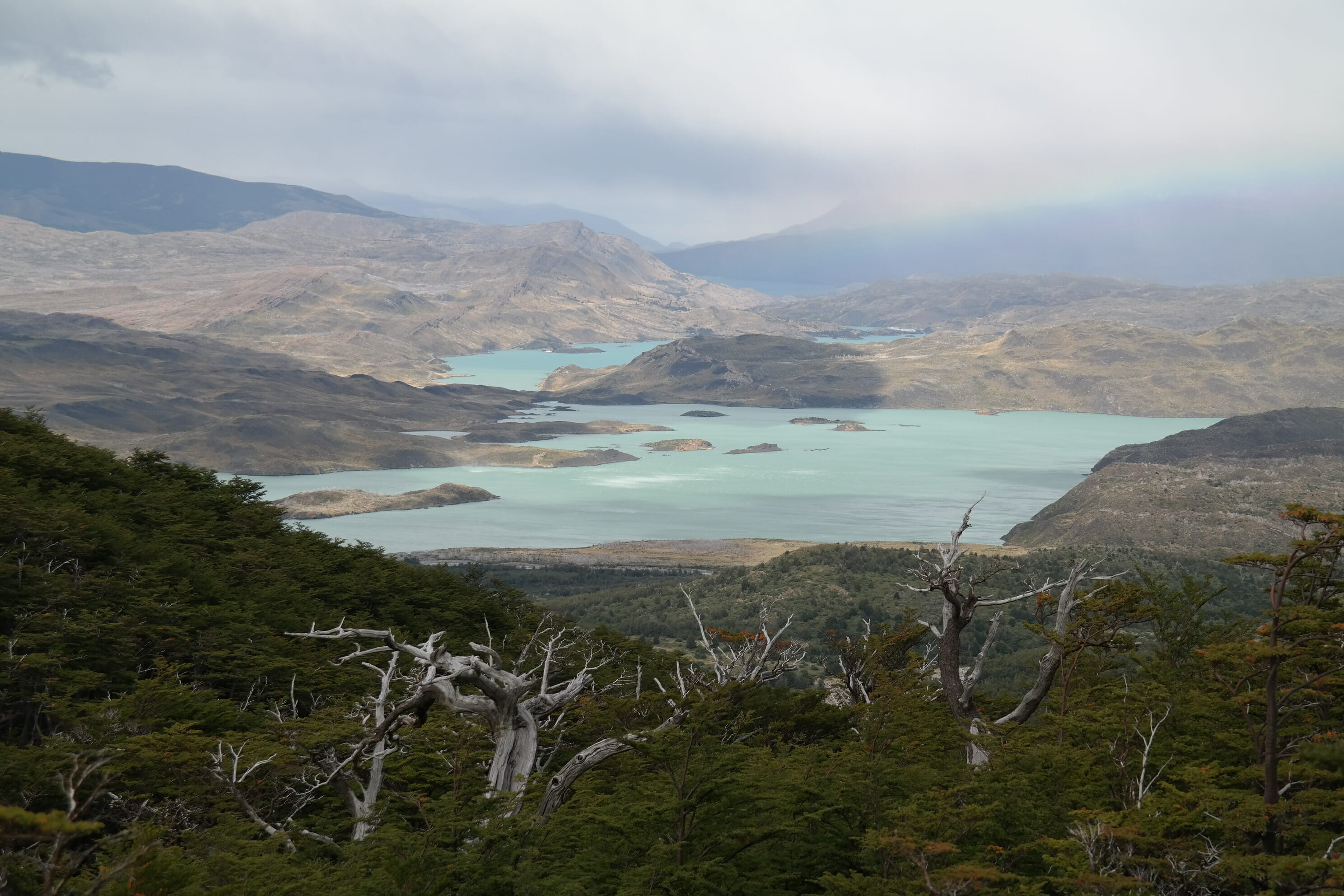
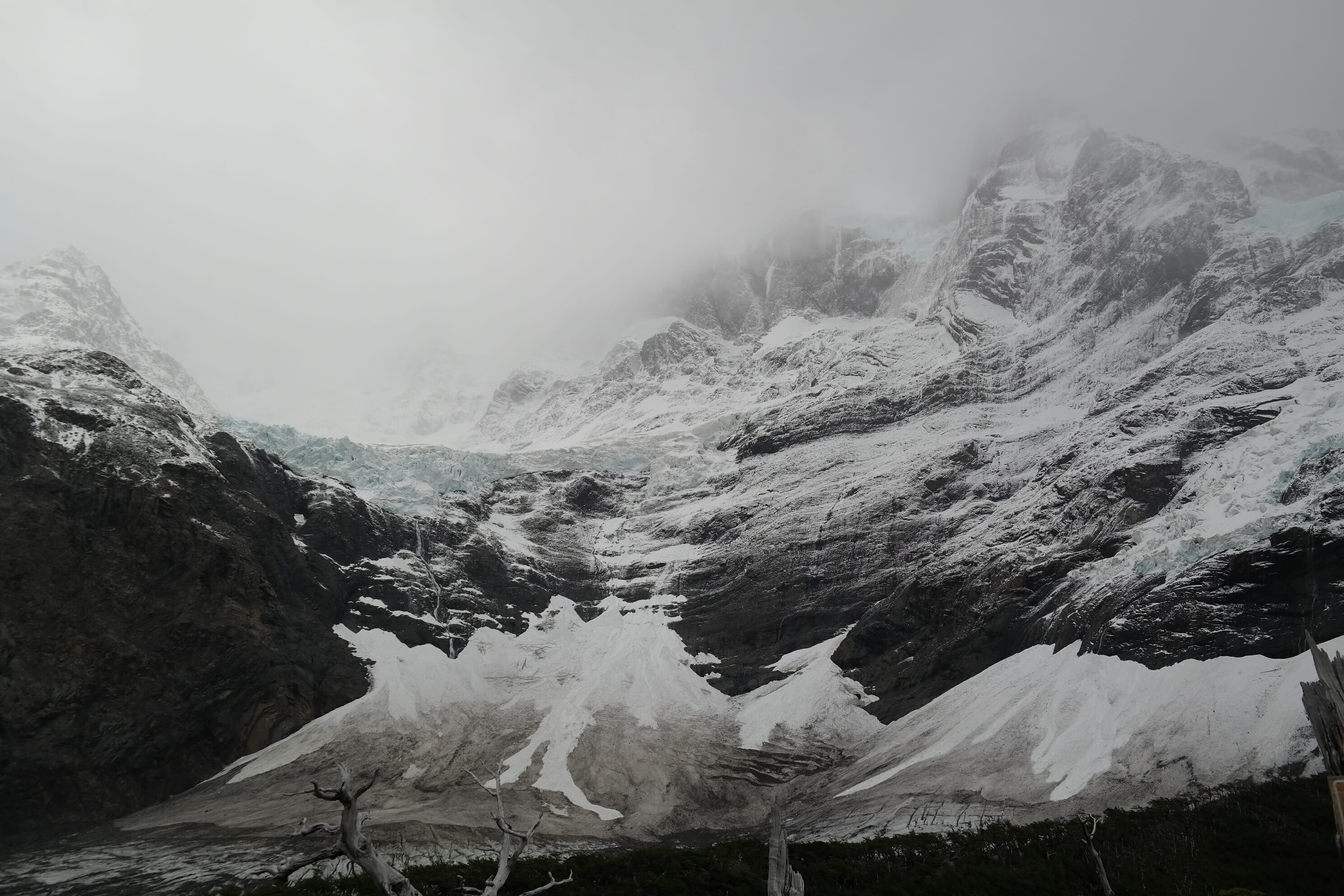 The wind was so strong it seemed to be about to blow people away. After taking some pictures we continued walking. After the viewpoint there were much fewer people on the path. The path seemed endless, it was now in the forest and all the way it was up. Sometimes we had to clamber helping ourselves with hands. Soon I noticed that it started to snow. Hands without gloves started going numb. We reached a point from where we saw the summit of the mountain where Mirador Britanico was, as we thought, because we could see people there. A very steep path covered with white boulders lead there that reminded me the climb to Torres lagoon, but it was so much warmer there. After seeing this I had a real meltdown, tears started rolling down my cheeks. I realised that no power in the world would make me climb that mountain, after a few hours of continuous strenuous ascent. Thoughts were running through my head: “It is sheer craziness to go up this mountain in this weather, it is plain dangerous”. It seemed strange to me that the mirador was still open for tourists. Later we found out that the viewpoint was indeed closed shortly after this. I didn’t want to upset Igor who had far more stamina than I did and didn’t want to spoil the walk however I couldn’t find an ounce of strength in me to continue. Igor didn’t insist on continuing and we turned back. Until this point we had walked 4 kilometres. Thankfully the way back was always down. The hardest bit of the path was the one near the campsite – where we had to walk on the boulders, and it was not always clear which way to go and it was quite slippery so it’s important to take extra caution on this part of the path.
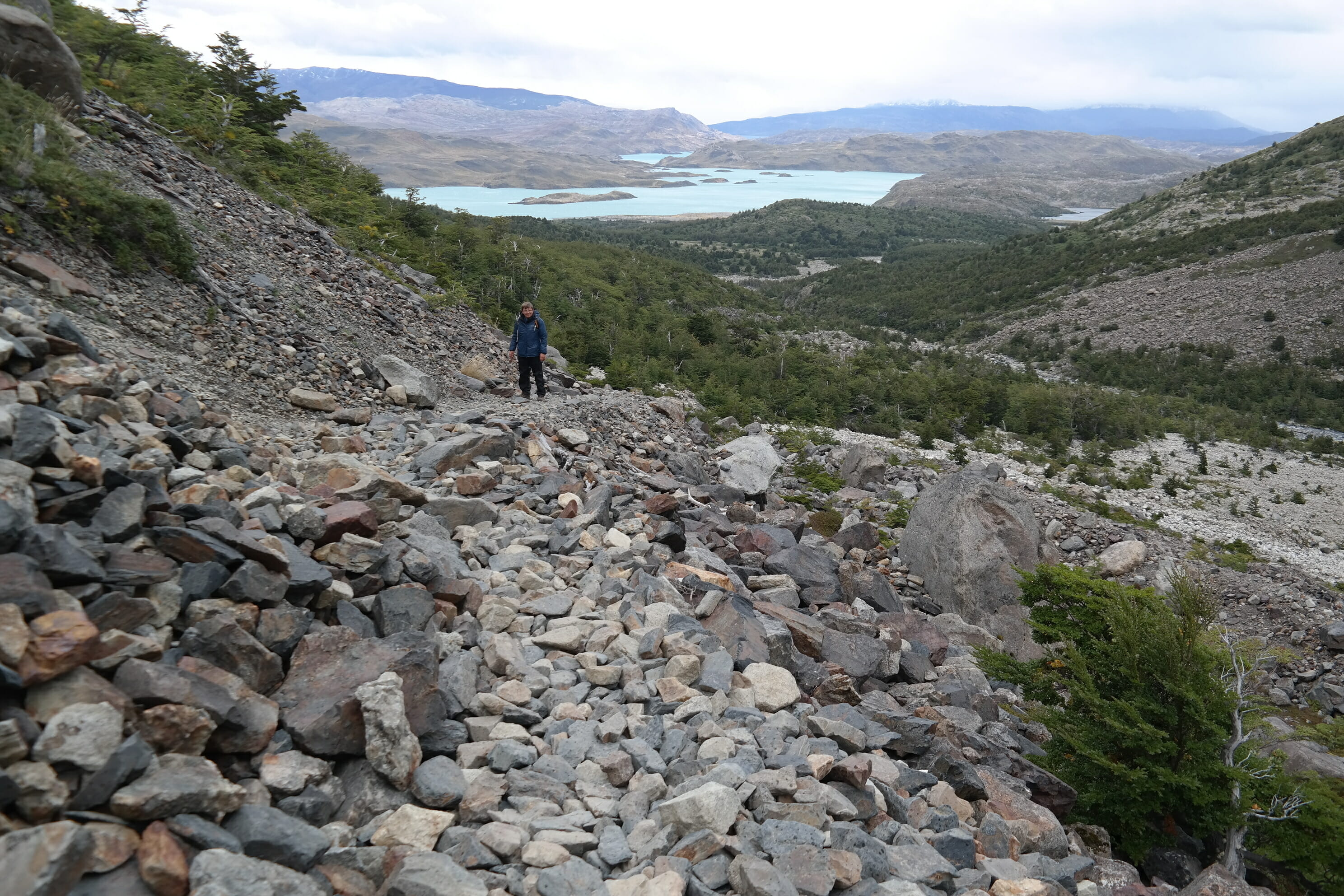
In the remaining hours of the day, after reaching Italiano, we walked to the nearby camping Frances which is a paid camping in a couple of kilometres from Italiano, if you walk back towards Torres. We bought some bread and chocolate there and went back.
Next day was our last day in Torres del Paine, as we had decided the day before. We set off on our road to Paine Grande, cheered by the fact that it was the final effort to make. This part of the way was the easiest, as there were no big climbs on it. However it was the part of the way when strength deserted Igor. Having to carry the huge backpack got the best of him. He became gloomy and grumpy. He used every chance to sit down – or it will be more correct to say, to fall down on his back, to land on the backpack and keep lying like this.
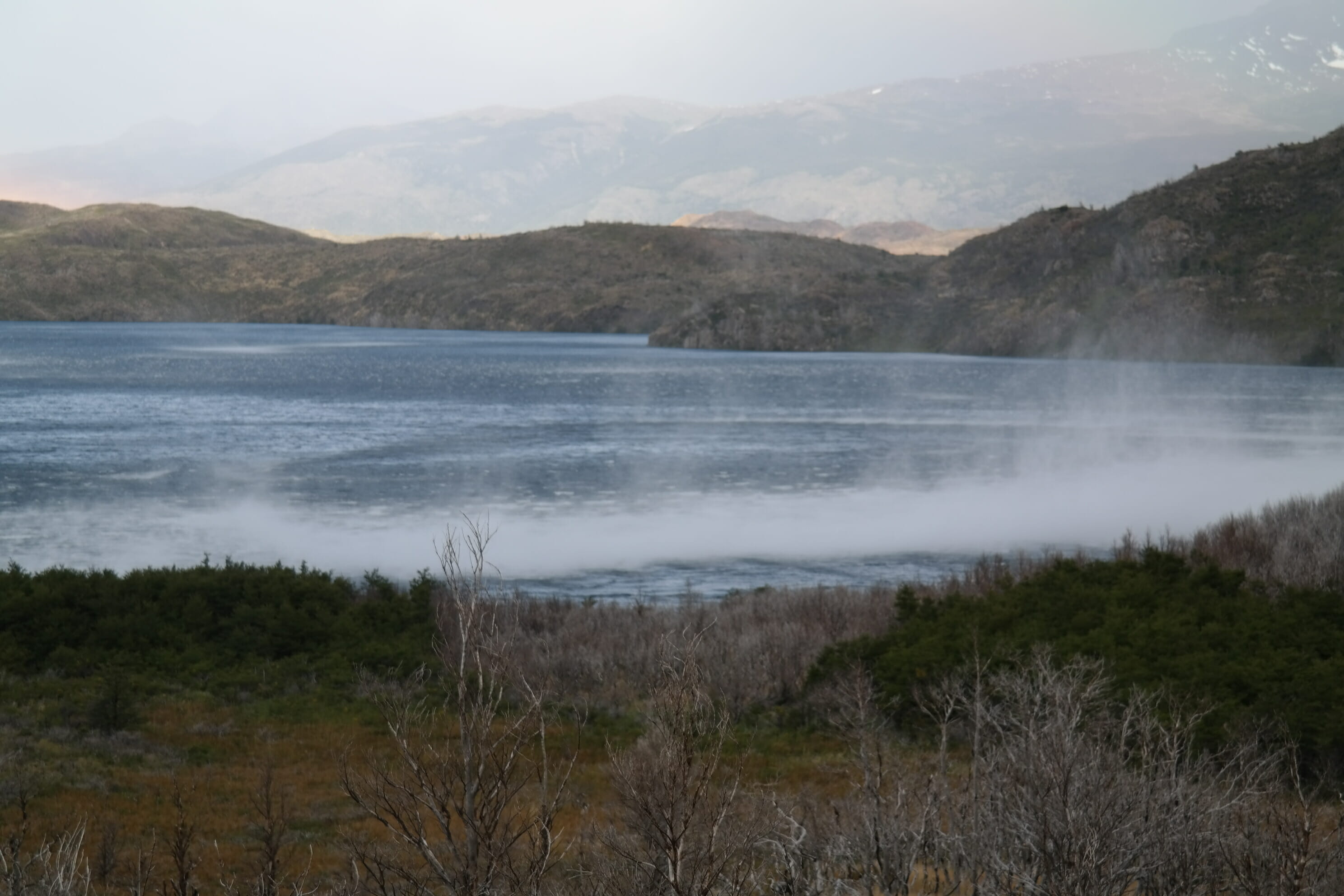 There was an amazing phenomenon which we witnessed on one lake. The wind was creating fountains of water on the surface and moved those fountains along the lake. Sometimes it lifted a whole wall of water and it dashed over the lake towards the bank. It was a fantastic sight like we had never seen before. I got stuck there taking pictures and video. By that moment Igor was repulsed by anything that surrounded us, such was the degree of his exhaustion.
We kept on walking somehow and the path lead us to a valley between the mountains. The moment we entered the valley, we were hit by the hurricane wind that nearly knocked us down. “Let’s move faster, – Igor said, – we should try to go through this place as soon as we can”. We hurried up along the path that was going along the side of a small hill. Here our walking turned into a sheer circus show! The wind found amusement in tossing us from side to side.
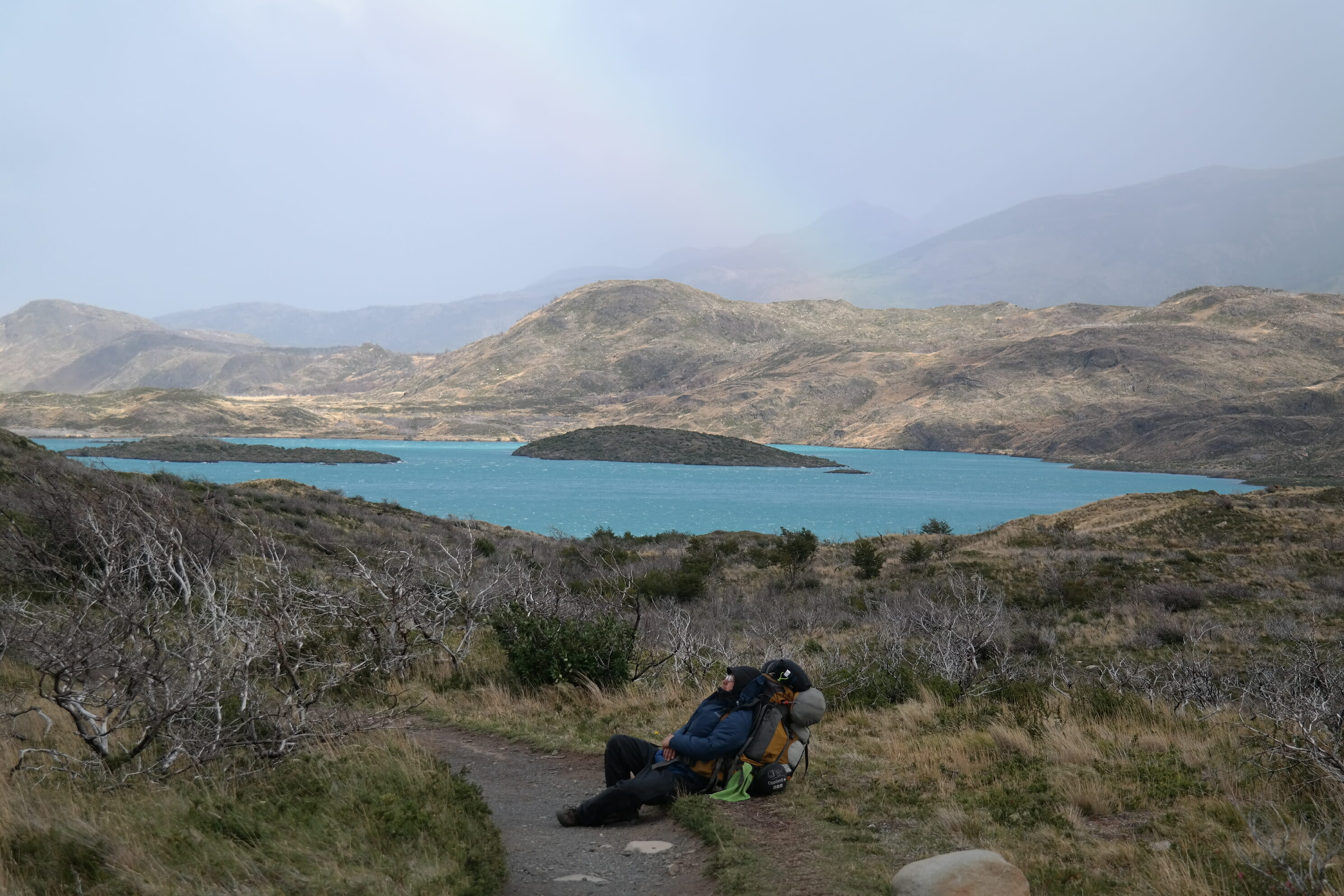
On the right there was a drop – a small one, but still a drop. On the left there were some thorny plants, very uncomfortable to grab. Thankfully the wind was blowing towards the hill and not vice versa so at least there was no danger of falling down the hill. Once it blew a bit stronger and I found myself landing on my knees right on the thorny plant. After a while it knocked Igor’s glasses from his nose and sat me next to the path. I was sitting there and laughing, and Igor thought I was laughing at how he had lost his glasses. To me, the whole situation seemed hilarious. Sometimes people were walking from the opposite directions, and they had to grab each other in order not to fly away. One way or another, we managed to slowly progress on our way and soon a fantastic view appeared in front of us – a heavenly blue lake. We had seen a lot of shades of blue and green, but we hadn’t seen such a saturated, vivid colour. It was Pehoe lake.
We came to the lake and walked along it, and then we saw buildings and tents in the distance. When we 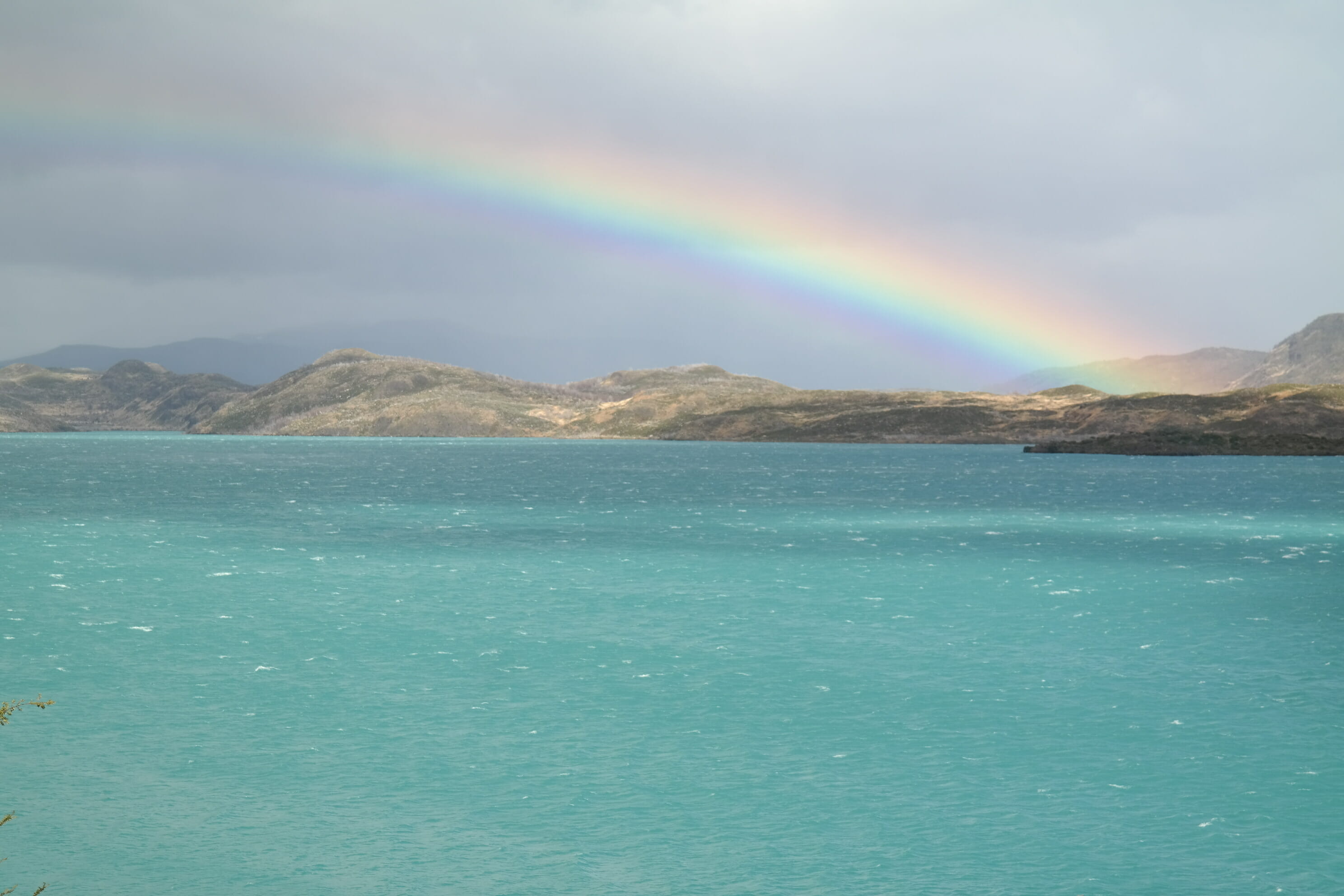 approached the place, we saw that the wind was shaking the tents like crazy. I can’t imagine sleeping inside such a tent.
We were not considering spending the night here, only in case we got unlucky and wouldn’t catch a ferry. But everything was all right. The next ferry was due to come soon, and we had time to cook lunch. There was a good canteen where we could cook the food and eat. Then we went to the jetty to wait for the ferry. The others didn’t care that much – they came to the jetty when the ferry already arrived. We came half an hour in advance and were the first in the queue. A huge crowd was behind us. Later we saw that all this crowd fit in the ferry without problems. It was us who had a problem because everybody else’s luggage ended up on top of ours!
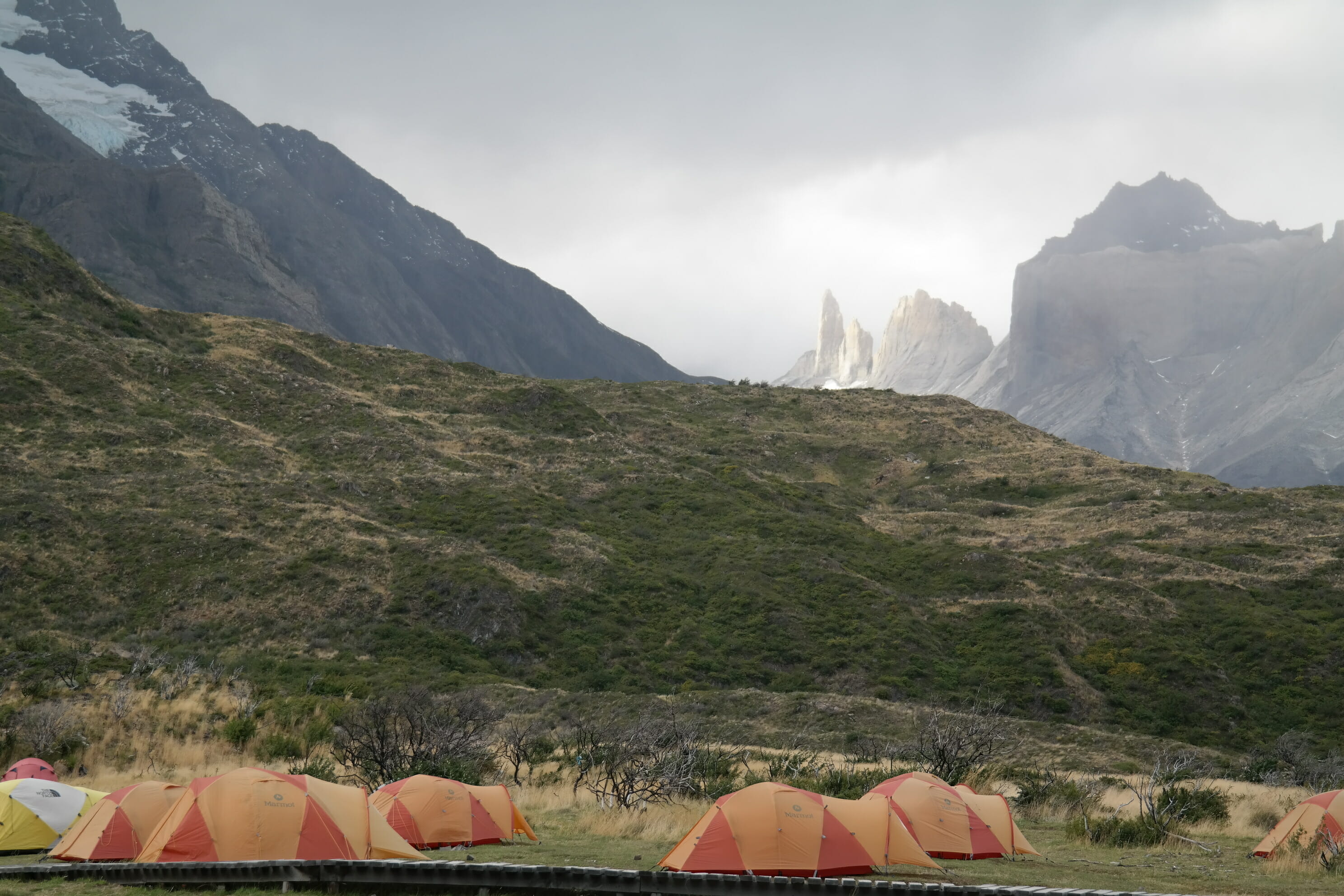 …One last tour in the park and the view on it from water – a new perspective. It was spectacular, especially with the heavenly turquoise waters of Pehoe lake as a backdrop.
After we arrived, we walked for five minutes to where the buses were waiting for all the people from the boat. Our bus was among them, we had bought tickets in advance in Puerto Natales.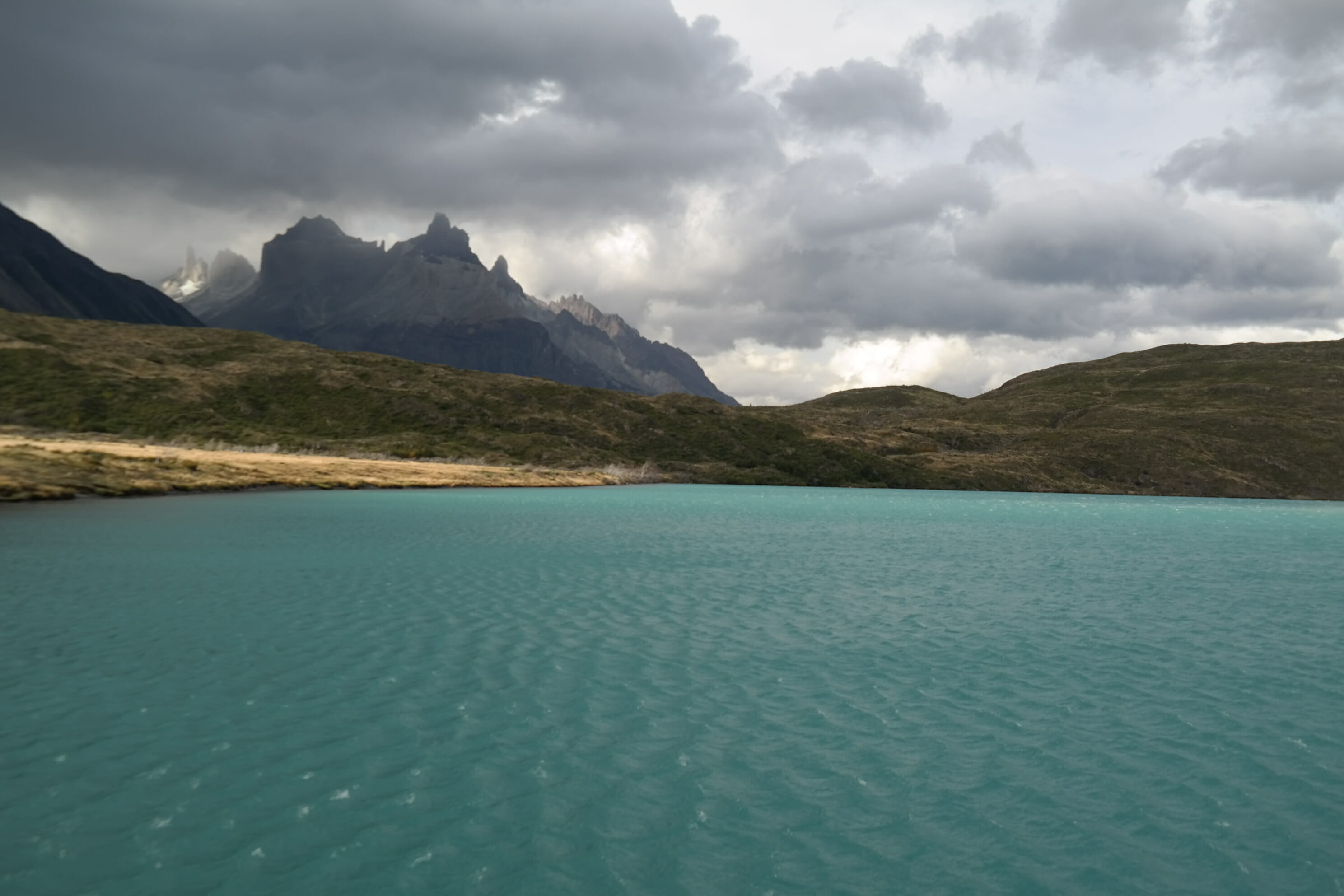
We were back in Puerto Natales when it was dark already. We had warned “Babushka Anya” that we might come late, but when we came and started ringing the bell, nobody opened the door. Oh well, tired as we were, we went to look for another accommodation. Thankfully, every other house in Puerto Natales is a hotel or a guesthouse. We found a very nice hotel close to the lake and it was not much more expensive than babushka Anya’s place. It was warm, there was a shower and a soft bed – just what we needed.
Now, to sum things up, I would like to say that of course Torres del Paine has been worth of all the hardships and difficulties we came across, and it was worth going this far. The park is stunning. However we don’t recommend doing things the way we did. First of all, the park shouldn’t be left until the end of the trip. It is so much better to go there with fresh energy and eyes that are still hungry for beauty. Secondly, it is better to carry as little luggage as possible. It was the weight of the luggage that spoiled our impressions to an extent because we got tired too much and often didn’t have the energy left to take in the surrounding landscapes. And last but not least, it is wise to take your physical shape into account. Trekking in Torres del Paine is not the easiest in the world so you should not be too ambitious with your goals. However the way the campsites are located dictates the number of kilometres you would have to walk in a day, because you simply are not allowed to set up tents anywhere but at official campsites. One way or another, you should be prepared to a certain level of exertion.
It had become clear to us even before we reached Torres del Paine that we wouldn’t go further south, to Terra del Fuego, as we had planned before. No matter how enticing this name sounded to us, we felt we had been in Patagonia for too long. We wanted to go somewhere completely different – or at least somewhere warmer. We were tired by the Patagonian steppe scenery too. Shortly speaking, after returning to El Calafate the first thing we did was buying tickets to Buenos Aires, in order to continue our way to Iguazu Falls, Brazil, Peru and Bolivia.
But these are all subjects of future posts.