Hello to anyone who is reading this now.
It’s about time we shared something else about our South American trip – it’s the first anniversary since it ended 🙂
The trip is long finished but the memories are still alive. Many months ago I wrote a post about our journey around southern Patagonia but never got round to publishing it. I am not sure whether there is anyone still interested in reading this, because even to us it seems that the trip was in the previous life. So, we probably are doing it for the sake of ourselves. To have some reading for entertaining ourselves when we are old 🙂
So, there you go.
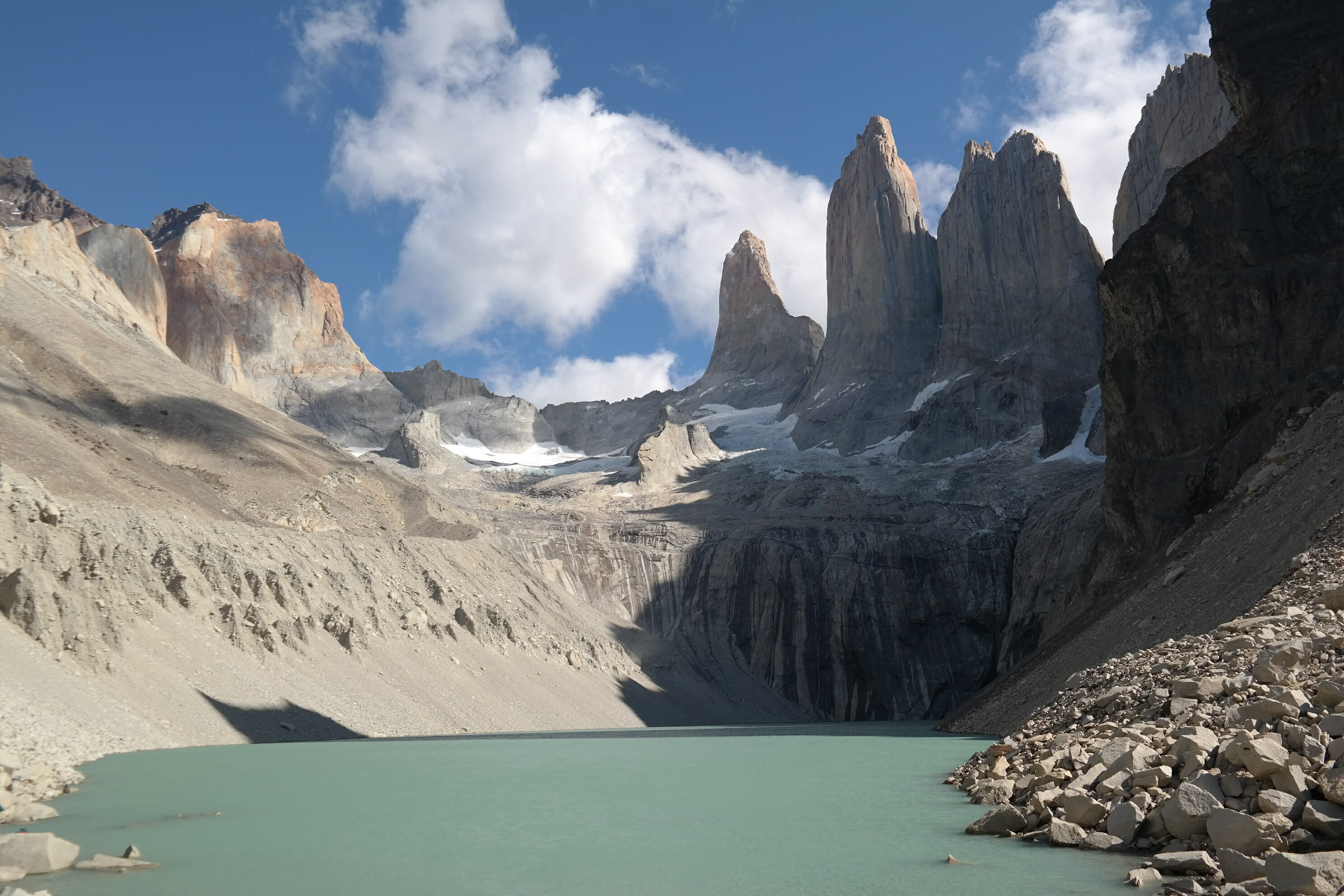
It often happens that a picture of some place on the planet catches your eye and has your heart set on it immediately. Your imagination completes the whole place on the basis of one piece, and you imagine this whole place to be absolutely outworldly, something out of a dream. The Chilean national park Torres del Paine once became such a place for me. I don’t remember which picture caught my eye, most likely it was Torres lagoon, as the most popular place. It was a lake of an incredible colour surrounded by oddly shaped mountains. It was difficult to believe that a place like that might be real, and I immediately included Torres del Paine in my list of dream destinations.
Therefore it was not to be discussed that after we came back from Carretera Austral to Esquel, we would continue our way to the south of Patagonia. We must see Perito Moreno glacier and park Torres del Paine with our own eyes. On the way we were going to stay for a few days in the place called El Chalten, which was also famous for its beautiful mountains and lakes.
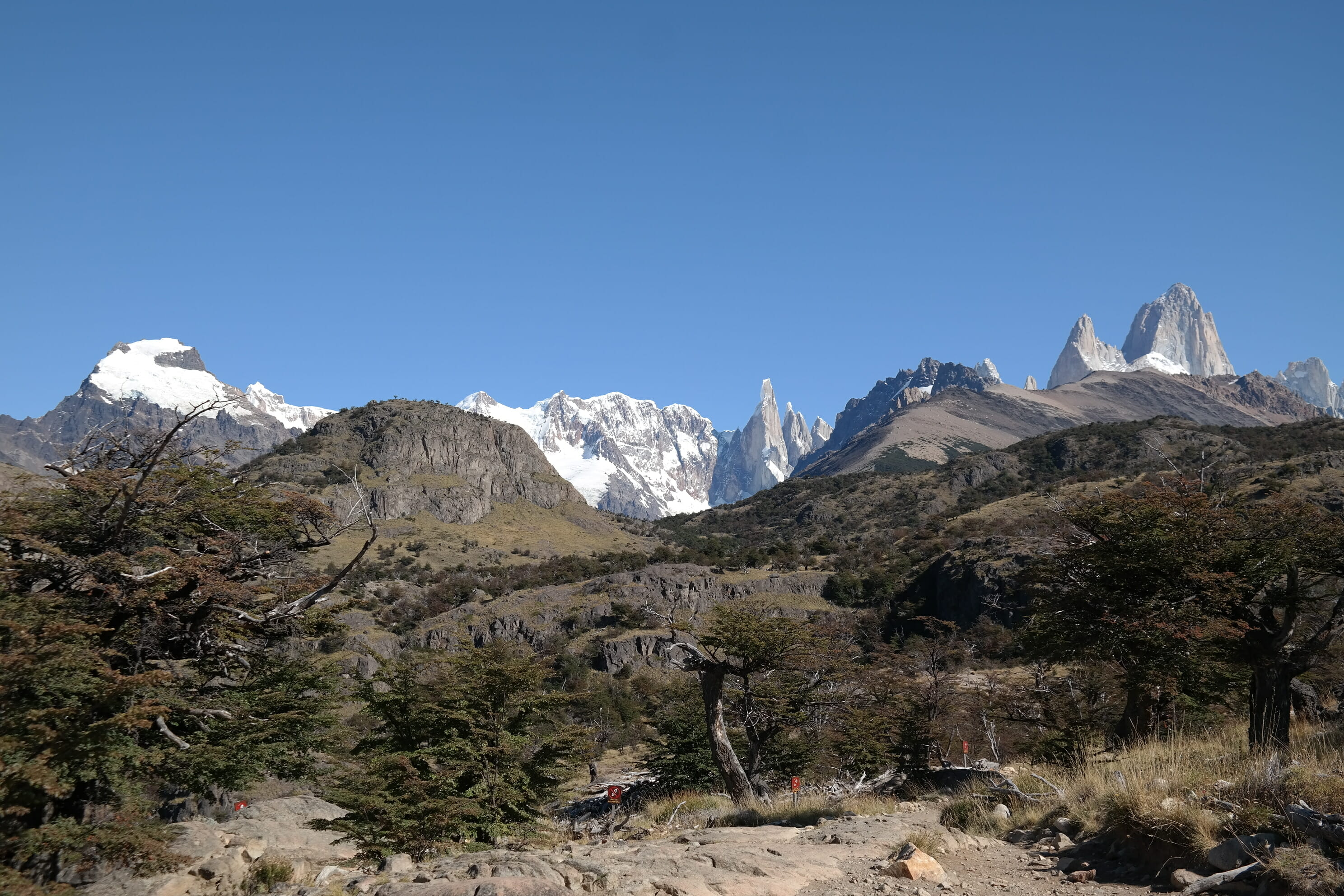 From Esquel to El Chalten we went in a boring way: by bus. This time it was easy to load our bikes on the bus and Marga Taqsa company which serves this route turned out to be great. In 17-18 hours we reached a small quiet settlement on the border of pampas and impressive mountain range of Fitzroy – El Chalten. We found a nice campsite there with a lovely view at a quiet stream passing through grassland, and at the mountains in the distance. We were lucky and only one of four days was quite windy. This part of Patagonia is famous with powerful winds, but experiencing the full power of these winds was still lying ahead.
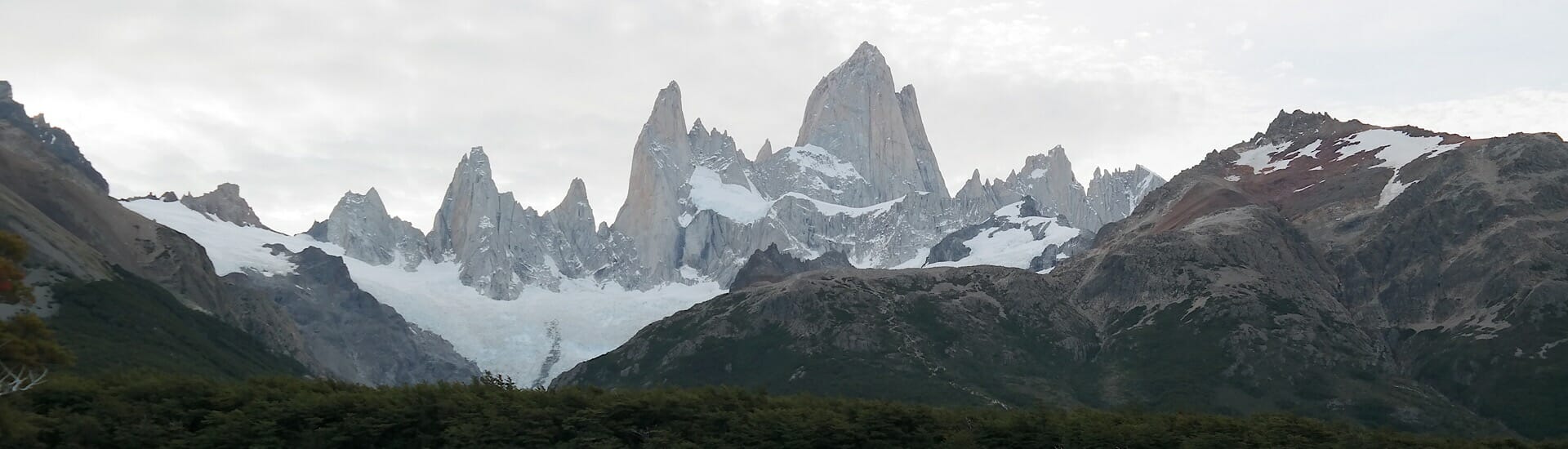
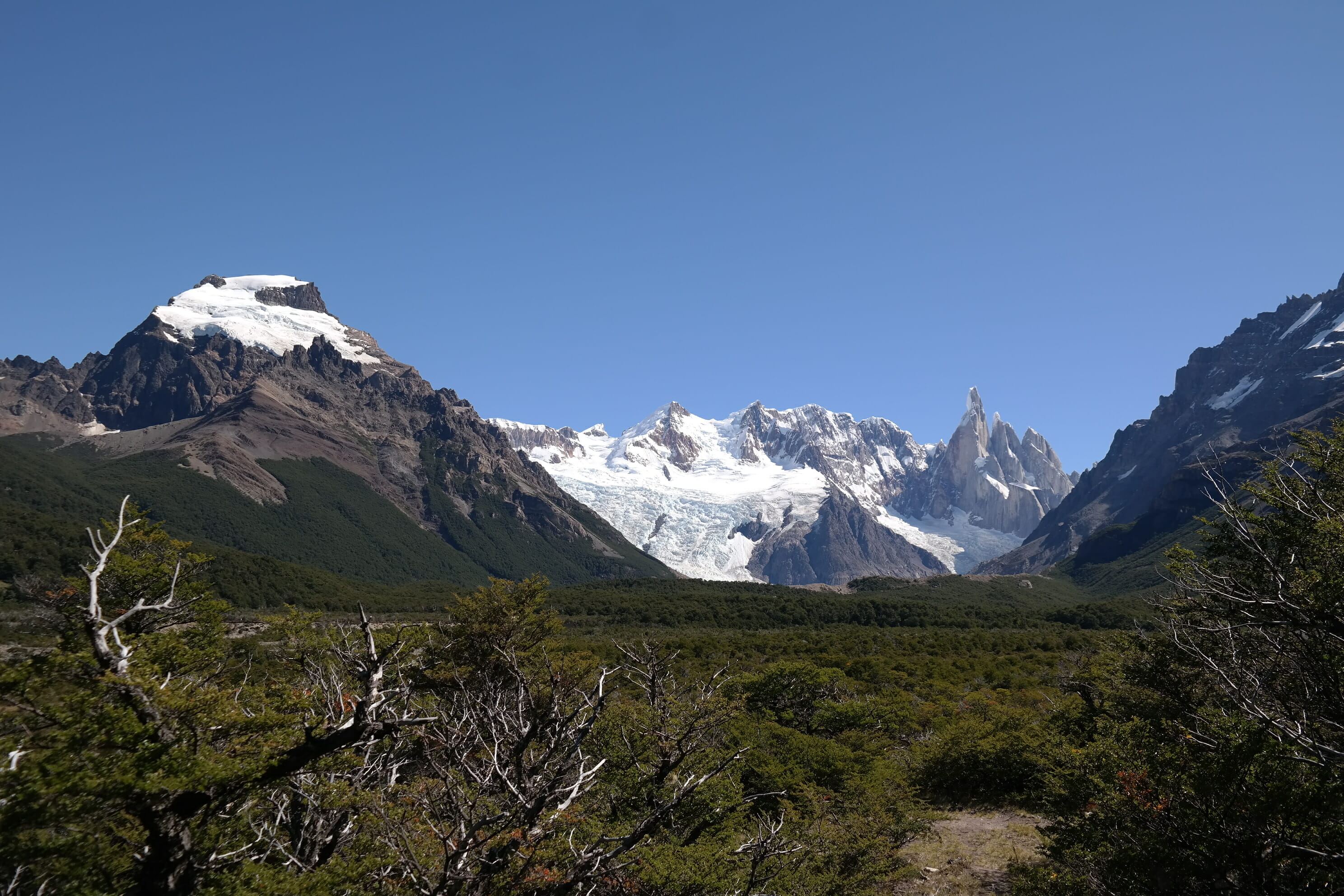 People come to El Chalten to see Fitzroy mountain. Climbers come to try conquering its summit, or the
 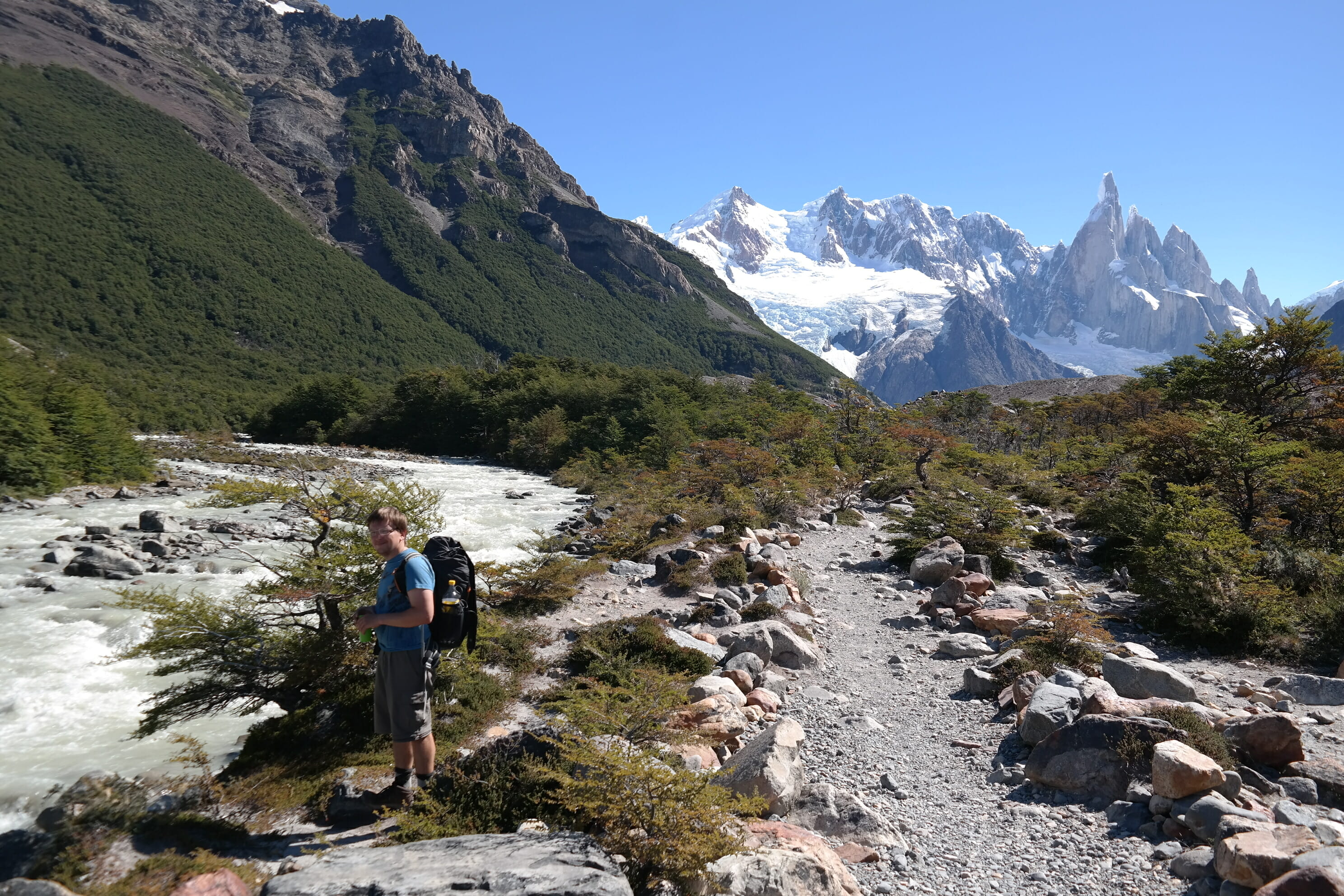 summits of nearby mountains. Ordinary tourists like us come for the sake of walking mountain paths and admiring the summits from afar. While we were there, we did two big hikes: to Torre Lagoon and Lagoon de los Tres, and one short walk to a nearby waterfall. All walks around El Chalten are very beautiful, but even those which are marked as “easy” in the guide book, present a real challenge for unaccustomed legs. Walks to the lagoons took us almost a full day each. We walked around 30 kilometers to Lagoon de los Tres and back
 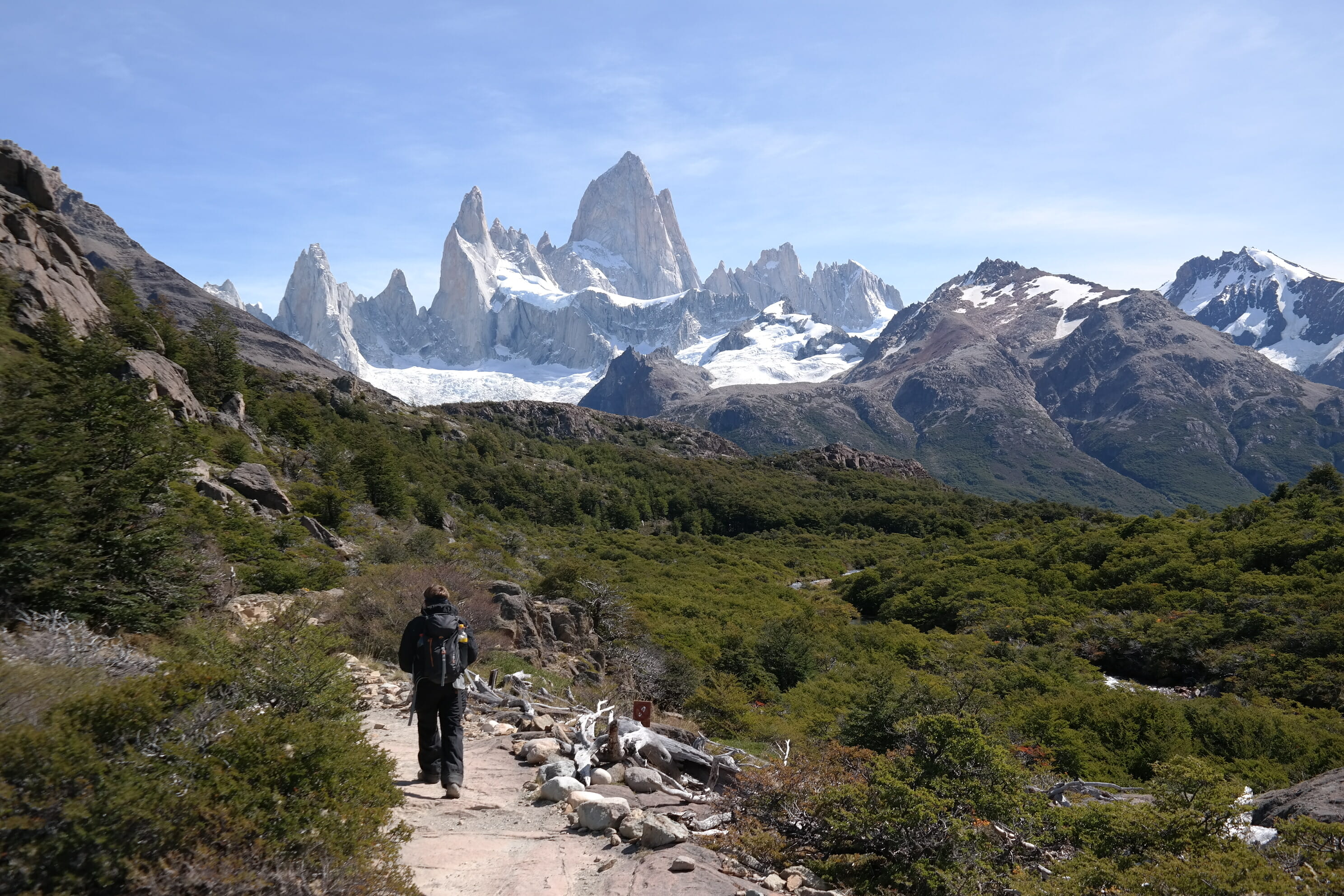 and returned to El Chalten when it was dark already.
When we were entering the town, I was making the remaining steps 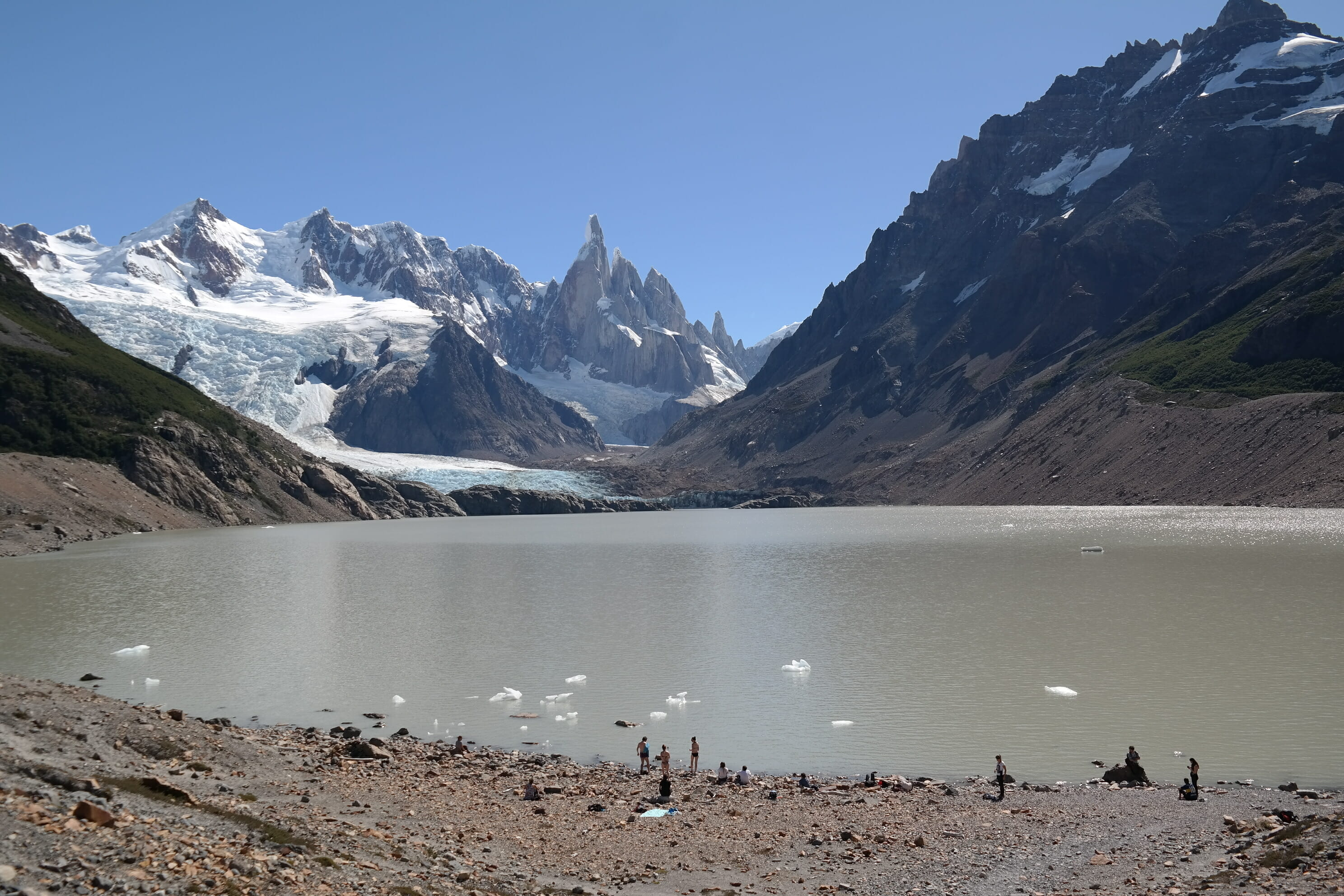 with my last ounce of strength, it’s hard to describe the degree of exhaustion our feet were in. We literally limped to the entrance of a restaurant. My thinking started getting confused. This day was one of those when looking back at the end of it, you can’t believe that you’ve made it, you’ve come this far.
It was so hard for the reason that before starting the climb to the lagoon you have to walk more than 10 kilometres from El Chalten. This walk is not extremely difficult, without too long ascents, but no way one can call it easy. The path runs on the mountains slopes, then in the forest: up and down. When you reach the beginning of the climb you are already quite tired, but you are in for the most interesting. At the beginning of the path to the lagoon there is a sign saying that you shouldn’t start the climb if you are not confident in your physical shape. I was far from being confident, but was absolutely sure I had to do it, otherwise why had I started this endeavour? Also, at the top there is the best sight ever, it can’t be missed. The sign said the climb is 1 kilometer long, but our GPS device eventually confirmed 2 kms.
This climb seemed endless to me. A decent path made way for stones very quickly. In the beginning the path was following these stones on more or less moderate slopes, which seemed never to end. At the moment when I started to feel like I was running on my last energy, the moderate climb ended having given way to a steep one where you had to climb from stone to stone, sometimes using your hands to help you lift yourself.
It’s a very interesting sensation – when you realize that you are running out of energy, but there is no light at the end of the tunnel. You start to feel desperate, but you can’t go back because walking back is equally challenging, and you also feel it’s too late to give up. It’s a great exercise for the willpower.
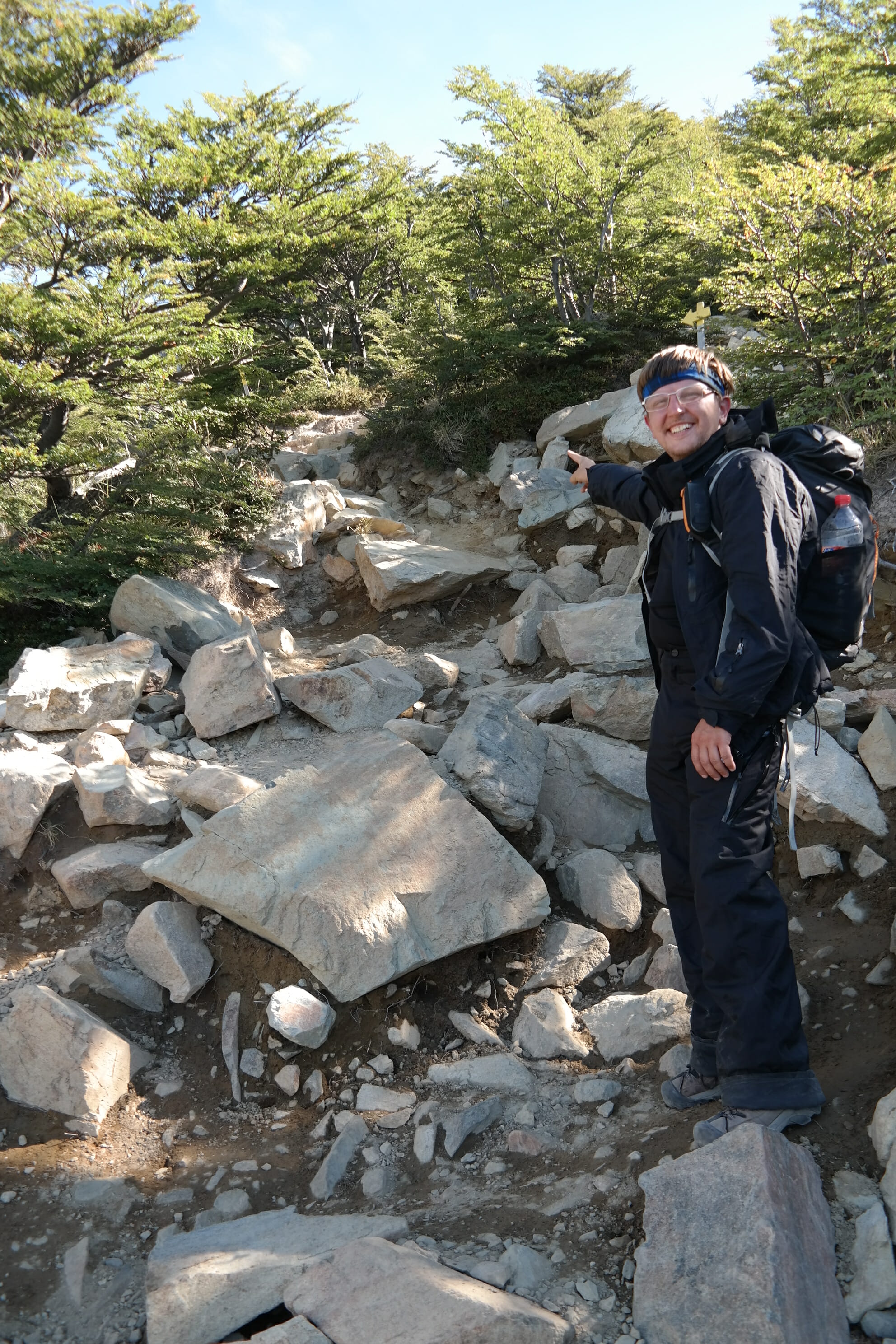 To make the climb more difficult, there was a constant stream of walkers who were making their way down, on a narrow path it was not easy to give way. But some of them tried to cheer us up saying: “You are almost there, guys, hold on” or “The view up there is out of this world, it’s worth it”. On the way back it was us who were saying the same things to the climbers.
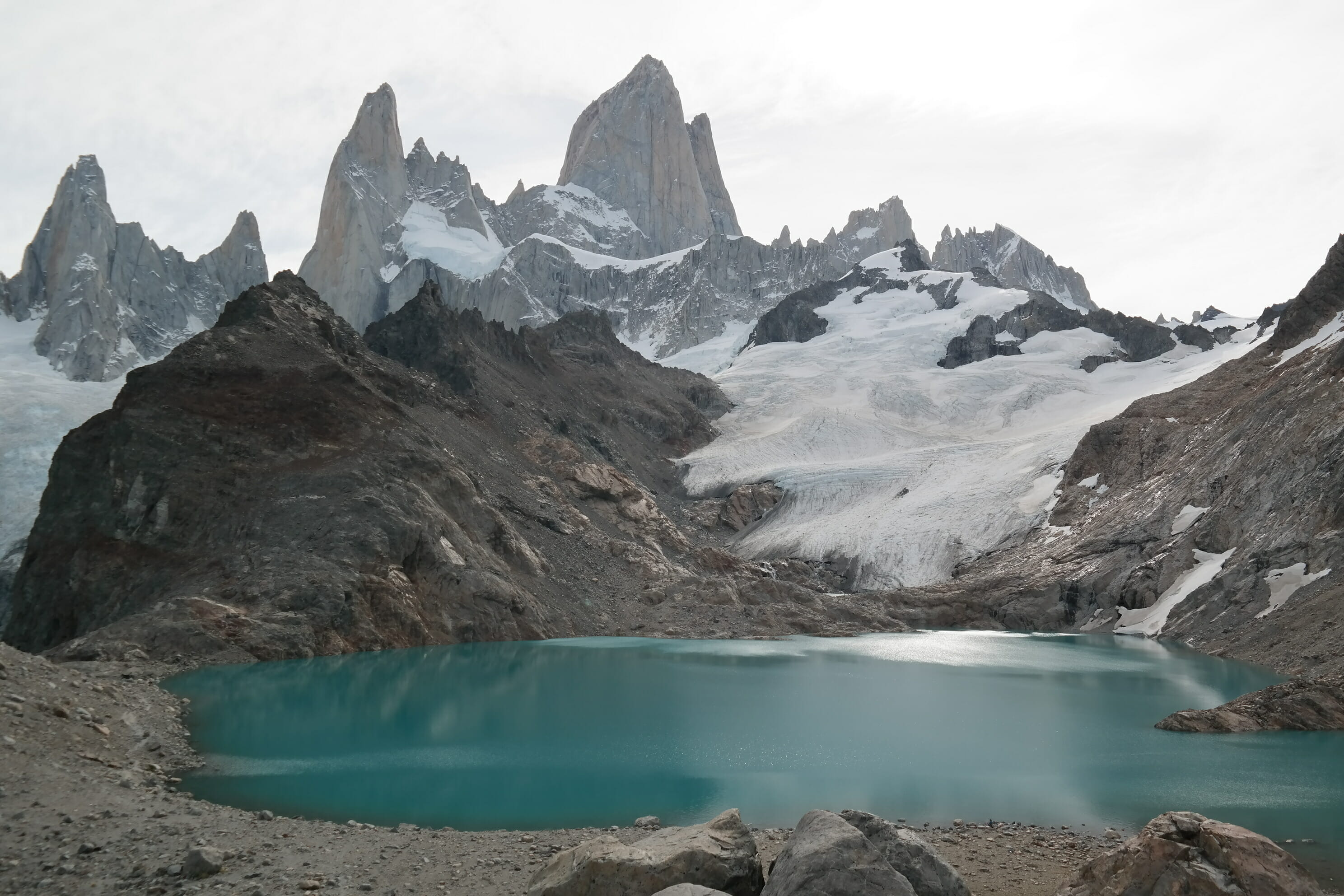 And this was indeed worth it! An emerald lagoon closely surrounded by mountains, with Fitzroy crowning them, is unparalleled. It’s simply out of this world. It’s where we heard the roar of a glacier for the first time. We were sitting there admiring the view when we heard the noise which sounded like thunderstorm, only the sky was clear and there was not a single cloud anywhere. The glacier apparently was at the back side of the mountains as we couldn’t see any ice falling down. The sound of glacier pieces falling down is typical for those parts of Patagonian south which are close to the ice field, and is quite awe inspiring, especially when you hear it for the first time.
To climb down from the lagoon on very tired legs is another challenge. We tread with difficulty, our knees and feet hurt. When we are finally down, we feel like we can’t make a further step. I lie down and let my feet rest a bit, and Igor is somehow capable of standing. It’s another 10 kilometres to El Chalten. There is a campsite nearby but unfortunately they don’t rent tents, so you need your own one. If we had known how hard it would be, we would probably have taken the tent, and would have climbed to the lagoon in the morning, after having spent the night in the camping. But nothing can be done now, we have to return to El Chalten, and we have to hurry up to make it till nightfall. We start walking quickly through the forest, grassland and on the mountain slopes.
In a few hours it starts getting dark, but we are already close to the town. We have the last spurt to make – to climb down a mountain near El Chalten which is not very easy because our knees had a lot to bear today. We met a bizarre couple on our way down: a guy and a girl were walking down without light. I suggested I walk behind them and light the way with our torch. They thanked us but the light from a small torch was not enough. The guy was almost running and eventually fell over his head. It looked like he could have broken some part of his body but thankfully he landed safely.
We walked together to the town and said goodbye to each other.
Our feet were in such an exhausted state that I was sure that tomorrow we wouldn’t be able to step on them, but strangely we felt ok on the next day.
There was nothing else holding us back in El Chalten and we were ready to move forward. We hadn’t ridden our bikes for a long time – for more than 3 weeks actually – and had our minds set on making our way from El Chalten to El Calafate not on a bus, but on our bikes.
We had started our trip as a bike trip, and until now we had only cycled around 400 kilometres. We had cycled in the northern Patagonia from Bariloche to Esquel, with a big part of our way being along roads with an intense traffic, and 70 kilometres had gone through Loc Alerces national park – this was a gravel road. Our route had traversed relatively populated areas. However the south of Patagonia is a totally different pair of shoes. It’s hard to imagine a less populated region. El Chalten with a few streets is a south Patagonian metropolis. The type of dwelling which you most often come across here is called “estancias”, which are similar to farms. When I say “often”, I mean every 50-100 kilometres. What’s between is a barren steppe.
Cycling in this region requires thorough planning, knowing where sources of drinkable water and shelters for spending a night are located.
We decided that now it’s time to test ourselves in these harsh conditions (and justify the fact that we had taken our bikes with us that far).
From El Chalten to El Calafate there are slightly more than 200 kilometres. For our purpose we can divide this route into three parts. The first one is around 90 kilometres and it follows Ruta 23 south-east, along the lake called Viedma (which in Russian sounds similar to “Witch” which makes it sound eerie). After that one needs to turn right, to the famous Ruta 40 and continue the way for roughly 95 kilometres south, after which turn west and follow Ruta 11 for some 30 kilometres more.
On this way there is only one inhabited area marked on the map, it’s called La Leona.
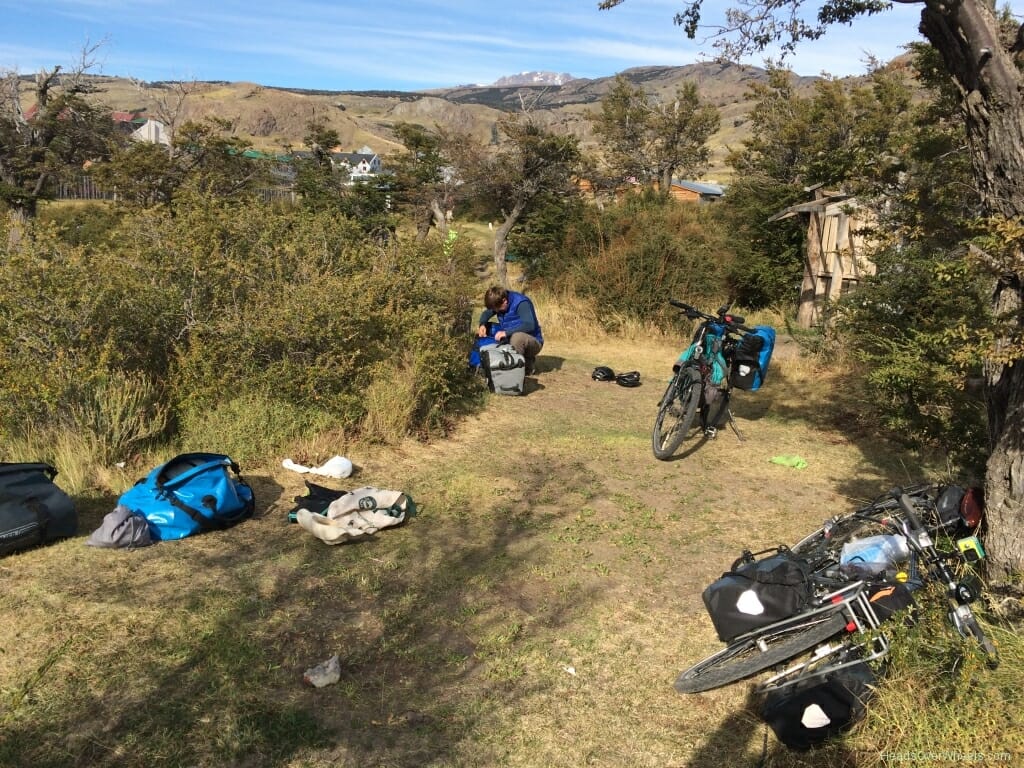 Our last day in El Chalten we devoted to preparing for the journey, i.e. mostly to buying supplies. We bought as much water as we could carry. We placed three bottles of 1.5 litres to the bottle holders on the bikes, and we put some more bottles (3 or 4) to one of the back bags.
On the next day after breakfast we packed and left the camping at an unusually early hour – 11 am. A couple of hours, as usual, had been spent on packing the tent and attaching the bags to the bikes.
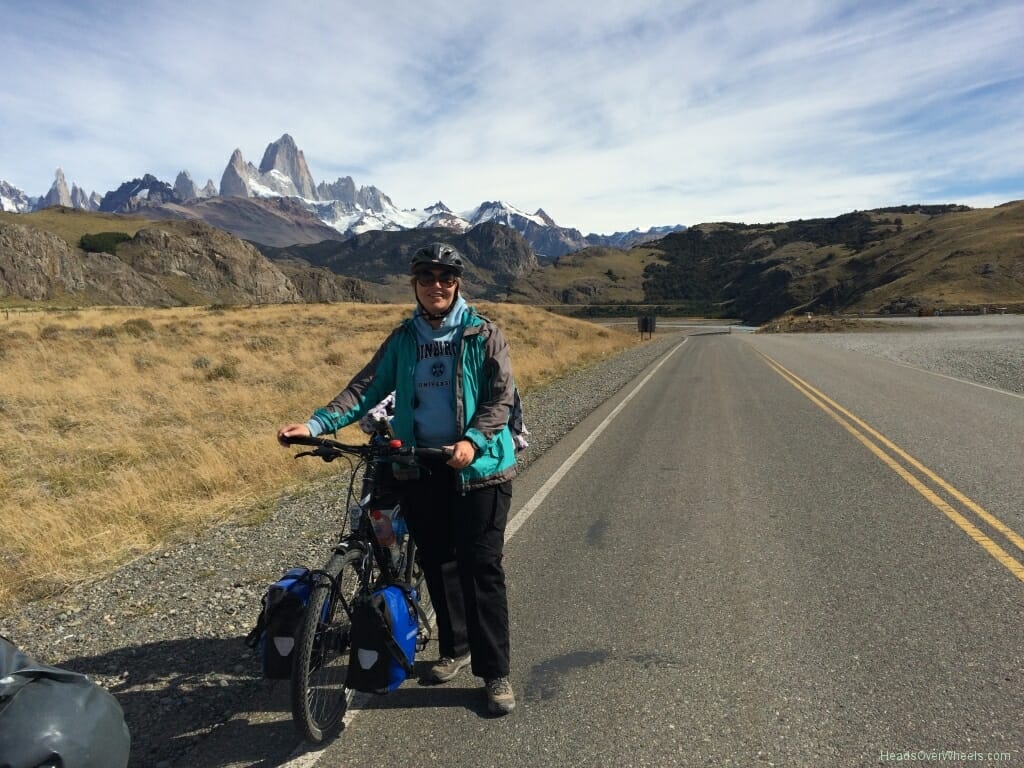 We had to make a push in the beginning – as we had to leave El Chalten by climbing not a very high but long hill. After having pulled through, the road turned to pure bliss. The deserted asphalted road cuts through the steppe, on the left side in the distance there is a mountain range, Fitzroy is behind and on the right side in a short distance there are blue waters of Viedma lake. The mountain chain behind was very beautiful, it looked like a fairy tale castle, and this receding picture smoothed over the first hours of our trip becoming smaller and smaller, eventually vanishing out of sight. The road went downhill sometimes, allowing us to gather some speed, or went up, but the ascents were insignificant and didn’t tire us too much.
 Cars were passing us rarely and the passengers often cheered at our sight. Viedma lake enlivened the deserted landscape a bit, without it the latter would look depressing. The view of the water was soothing, and owing to its heavenly blue the landscape could even be called beautiful.
We often stopped to take pictures, and for the rest of the time we pedaled, looking around, listening to music or were cycling side by side and chatting. This first day of the trip was by all means the most enjoyable. We were feeling all the positive sides of the bike trip, and negative sides were almost absent. There were neither speeding cars nor strong wind, the weather was fine and the asphalt was smooth. There were even no steep climbs. The landscape was a bit laconic but not ultimately boring like one could expect from the Argentinian pampa. Our bags were full of water and food, and we were full of energy. What else could be wished for?
After just having left El Chalten, we met three cyclists going in the opposite direction. They were two guys and a girl. We stopped to chat with them. I think they were from Spain. They were on their way from El Calafate to El Chalten. They were not fellow travellers from the beginning, the girl joined the guys on the way and they continued together. Before that they had cycled all the length of Carretera Austral. This is definitely admirable. We told the guys about El Chalten, gave them the walking map which we no longer needed and continued our way.
After a while another cyclist caught up with me (Igor was cycling a bit ahead). 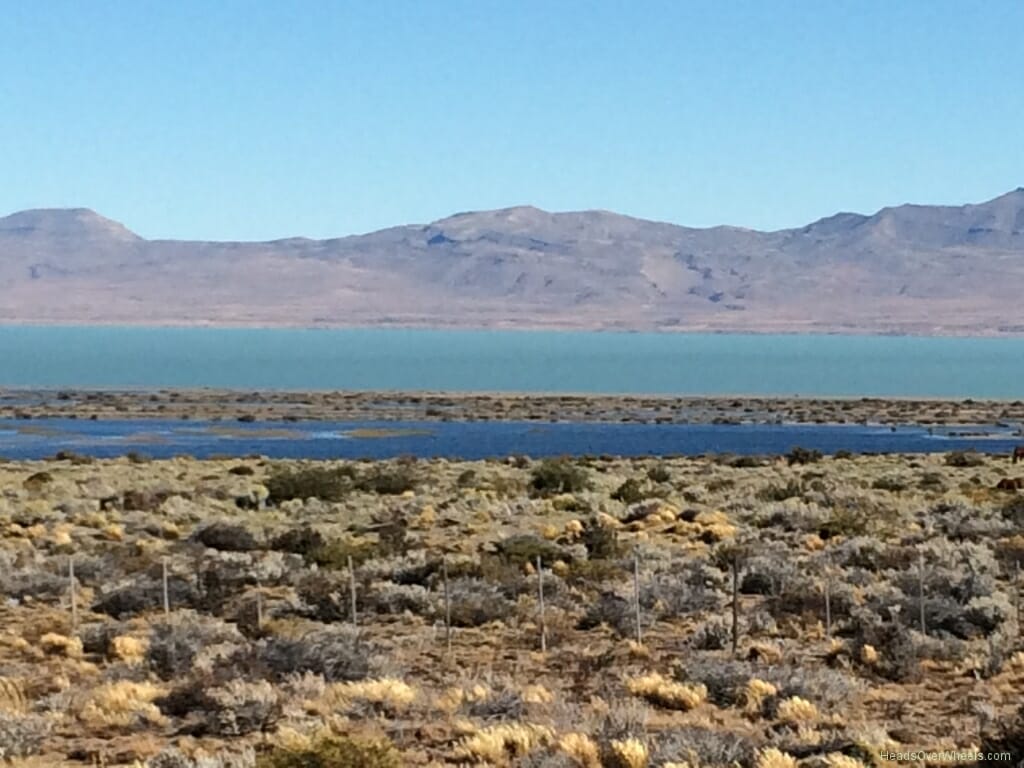
- You were in the camping, – he said, saying the name of the campsite. – I was there too.
I felt a bit ashamed for not looking around and not noticing the neighbours at the camping.
We got to chatting with him. His name was Heiko and he was from Germany. He looked 35-40 years old. He had taken a long holiday at work and had gone cycling to South America. He had been to Bolivia, Peru and came here through the north of Chile. Just like with three guys we just met, we were no match to Heiko as cyclists. He had made almost all his way cycling, including Carretera Austral. He had only made a part of his trip by bus – the desert in the north of Chile. Heiko was beaming with happiness because he had finally made it to the asphalt. He had come to El Chalten directly from Carretera Austral which is almost all gravel, pits and holes, and the passage between Villa O’Higgins to El Chalten is off-road.
We asked him how he felt about these kinds of challenges, and he said that it was similar to passing different levels of complexity in a computer game – when you are passing through one challenge and can’t fathom what’s next. I think it’s a great way to think about it.
Heiko said that he had been going to see Perito Moreno glacier and go back, but he was enjoying the asphalt so much that he changed his mind and after El Calafate he would cross Argentina and cycle to Rio Gallegas – the town at the eastern shore. Heiko used to study Russian long ago and even managed to remember a few phrases. You could clearly see how comfortable he was with his way of traveling, it all looked like a child’s play for him. For example, when we were talking at the side of the road, he was standing closer to the carriageway and not a muscle was moving on his face when a car was blasting past him very closely. I guess this kind of self-restraint is necessary for going all the way he had gone.
Heiko’s traveling style was “I’m enjoying myself”. He took his time without setting any goals and not trying to go a preset number of kilometres. I was impressed by this, because I personally like to plan everything and to know exactly where we are going to spend the night. Heiko seemed not to be bothered by such trifles. He said that once when he had failed to find a decent spot for his tent, he had had to put it at a parking near a busy highway. He said that at night it had felt like big trucks were going right over him. I wouldn’t be able to sleep in such conditions, that’s for sure.
After chatting with Heiko we said goodbye and he moved forward. I was sure that we wouldn’t meet him again, because he was moving much faster than us, but this was not our last meeting.
We stopped for lunch, when we saw a place where there was some greenery. There was grass there and even a few trees, and horses were grazing at the roadside. There was an estancia nearby. We sat on the grass and made our lunch. Life seemed amazing, the road was easy and pleasant. If only all bike trips were like that, we could be cycling months on end!
Before on some days we were exhausted after having cycled 30 kilometres, and today we have cycled 40 or 50 kilometres and didn’t even feel tired. The Spanish guys told us that they had spent the previous night at the crossroads of Ruta 23 and Ruta 40. We were sure that we would make it by the evening, there are only 90 kilometres from El Chalten to this crossroads and we have already made half of this way. We have all chances of getting there and spending the night.
In the afternoon the road moved further from the lake, now it was passing through dry steppe. Not a single dwelling was in sight, sometimes we saw a few wild horses or timid guanacos. Without the lake in sight we started feeling less at ease. This area didn’t look much different from a desert. It was evening when we met a couple of other cyclists – a guy and a girl from France. They asked if we had passed any inhabited place and if there had been anything which could be used for spending the night. They looked concerned that there was not a hint at such place around. We had seen an estancia in a distance, closer to the mountain range on the left side. I had heard that some cyclists asked estancia owners to allow setting up a tent on their territory, so we gave this advice to the guys. Otherwise they would have to cycle more than one dozen kilometres until the next decent spot.
We already were concerned with the same issue. We were approaching the crossroads, but the terrain started to look less and less habitable. The steppe dotted with batches of dry grass was spreading horizon-to-horizon, and close to the road there was an endless fence of barbed wire separating us from the steppe, clearly saying we should not try to go beyond it. Even if we could physically lift the bikes and bring them beyond the fence, even if we could find a spot for the tent among the dry grass batches – it was not an option. We had a narrow piece of land between the road and the fence for putting the tent, but on this land for many kilometres we hadn’t seen anything which could pass for a shelter.
It started to get dark when we approached the crossroads. We had no doubts we reached Ruta 40: much more cars were on it than on Ruta 23. We were surprised to see a couple of hitch-hikers sitting at the crossroads. God knows why they happened to be here, in the middle of nowhere.
We tried to understand where the Spanish guys spent the night here. We couldn’t find any shelter. We could put the tent right next to the road where all drivers of all passing cars could see us, but I was not happy with this. There was a road sign at the crossroads saying that in 20 kilometres from here there is La Leona. We had cycled 90 kilometres by now and felt very tired. The sun was going down. It would be pitch dark in an hour, that’s for sure. We hardly had energy or daylight left to reach La Leona. What shall we do now?
We decided to keep cycling on Ruta 40 and look around in case there was any hill behind which we could set up the tent. We stopped at anything which remotely looked suitable. Once we saw a tunnel next to the road, but upon closer examination we saw it was used as a toilet. There were plenty of such tunnels but unfortunately, none of them were suitable for spending the night inside or next to them.
Hills were rare. One of them looked ok, but on the back side it was much lower than from the road side, and behind it I found a guanaco skeleton. I hurriedly left the place.
We were more and more worried because now the sun was touching the tops of the mountain range ahead. Its light was blinding for us and for the cars going in the same direction which made us feel unsafe on the road. I thought we would have to continue like this to La Leona, but suddenly we saw a glimpse of water. The lake!
No doubts that the road lead us back to the lake. It was great news. However to see the lake is one thing and to approach it is another. The lake was separated by the barbed wire from us, just like the rest of the land. We decided to come closer and check if there was any loophole.
The main road was bending to the left after a while, and we saw a dirt road going in the direction of the lake which looked more like tyre marks. We left the main road and followed the tyre marks and having reached the fence we saw a gap in it. Finally luck was on our side! We dragged the bikes for about 500 metres on the sand and eventually reached the shore of the lake. The soil on the shore was not the best, it was sandy and there was dry grass everywhere, but there were a few spots free from the grass. One of them was on a lower level as if the ground collapsed here, which made it a big pit with walls on three sides. It looked like a good shelter for the tent. After looking around we spotted another tent in a distance and realised we were not alone here. Having looked more carefully we recognized Heiko.
Heiko came here a couple of hours before us, and having found this place ideal for the night, decided to stop here. He laughed when he saw us, saying: “You’ve got good intuition, it helped you spot the best place”. I told him about a guanaco skeleton behind the hill next to the road. Heiko said: “Have a walk to the left from here, it’s all covered with bones”. It all sounded a bit sinister, on the shore of the lake which we called lovingly “Witch”.
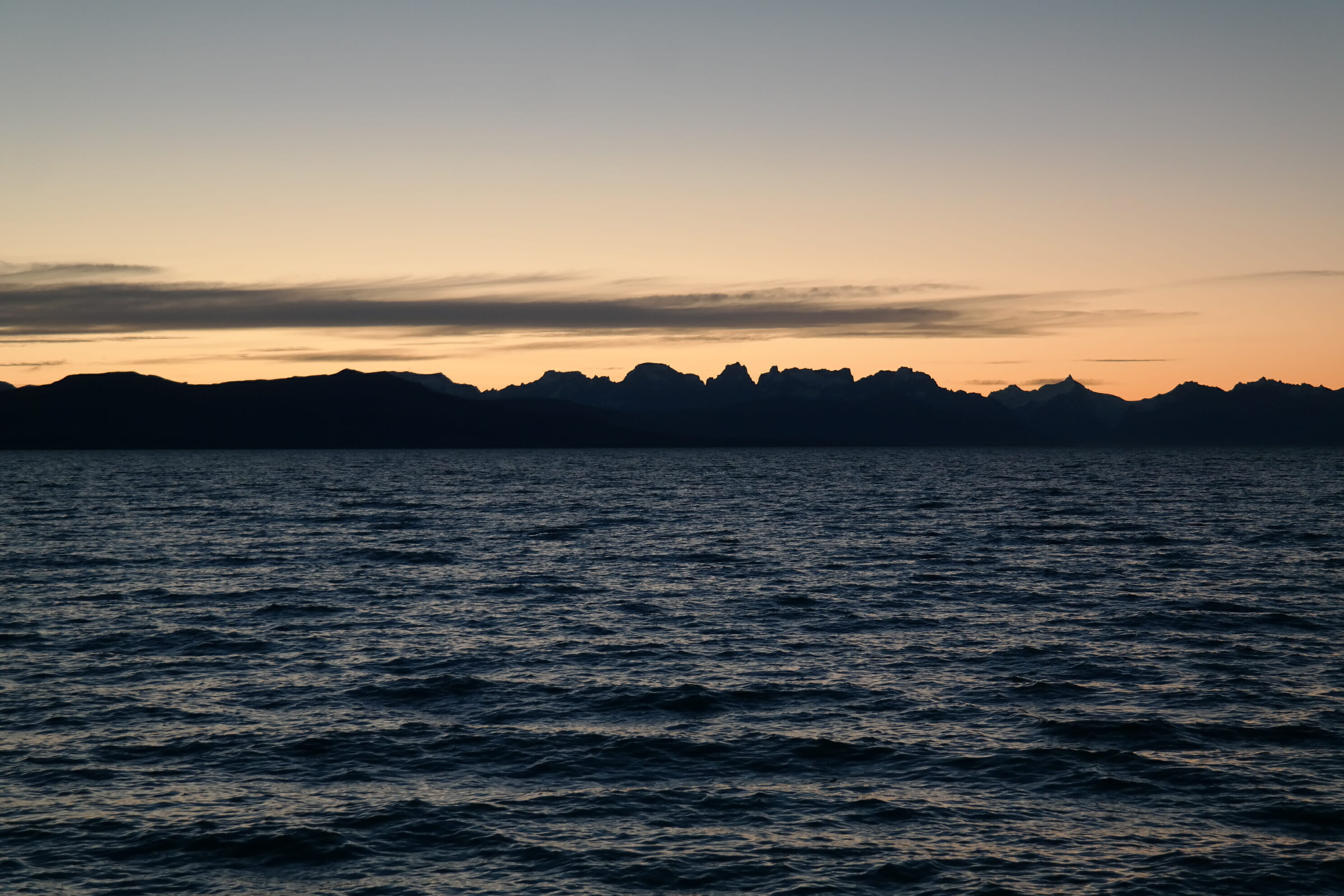 Heiko helped us to secure the tent on the sandy beach – he told us to find a few stones and pass the ropes around them. The tent pegs were useless in this kind of soil. The sun eventually went beyond the tops of the mountains and the sunset lit the tops from behind. The sky turned golden and we saw an amazing sight. The tops of the mountains had the most peculiar shapes. One of them was square topped, another one looked like a dome. All together they looked like an oriental town. It was weird to realize that this was all but a mirage, and what looked like an inhabited place was indeed lifeless stones.
The illusion quickly faded away and the lake sank into darkness. It was time to sleep.
The sleep was restless, I was constantly waking up and listening to a slightest rustle, my head full of paranoid thoughts. I was sure I could hear some strange sounds. It started to get windy in the middle of the night, the tent started flapping. I also started feeling a strange numbness in the palm of my left hand but I thought that was because I slept in an uncomfortable position. All in all, the night was uneasy, but eventually I managed to steal a few hours of sleep, and soon it was morning.

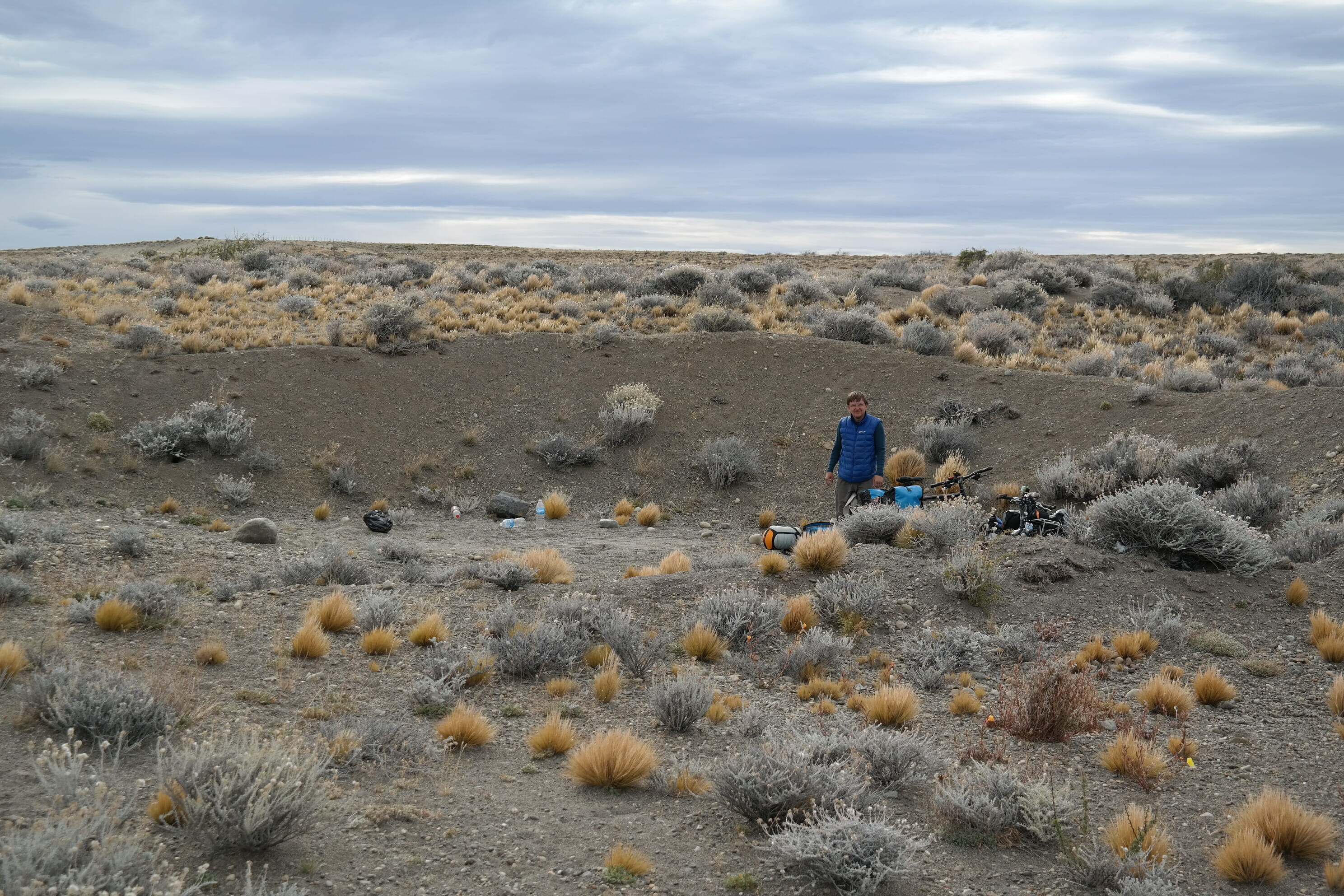 The morning was gloomy, the lake now was wavy and the sky was overcast with heavy grey clouds. It was windy. Heiko woke up and was getting ready to leave. We had breakfast and started packing too. We were ready and left the place at the same time. We reached the main road chatting about traveling, and said goodbye to each other, and again I thought this was the last time we saw Heiko. And I was wrong again, we had our third – and last – meeting with him a few days later when we met him in the crowd near Perito Moreno glacier, he was watching the ice bridge collapse just like us. He was as lucky as us to happen to be in the right place at the right time.
Having said goodbye to Heiko, who quickly cycled forward, we started pedaling at our pace. The weather was a far cry from yesterday’s – the low clouds made us feel gloomy, and due to the constant strong side wind cycling was no longer a breeze (pun intended). The landscape was dull, with the only interesting thing being Viedma lake which now was on our right side, but we passed it very quickly. We saw a few guanacos but they didn’t come close to us.
…Before I had seen an animal in the pampa which had been crossing the road and looked like a tortoise. When I saw it for the first time, I felt like rubbing my eyes in disbelief, as I knew there were no tortoises in the pampa.
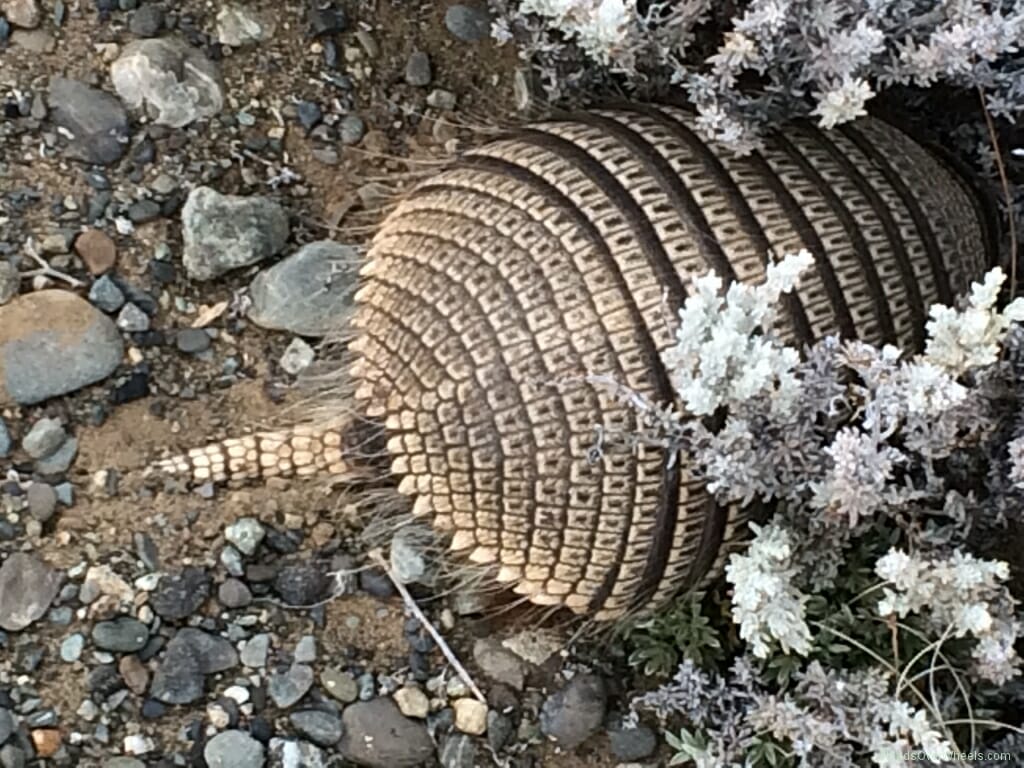 Today I saw this animal again and it seemed to me that after having crossed the road, it stopped on the right side. I approached this place where I thought it was and started looking for it in the bush. Then I saw it – it was a bizarre creature with a shell, which burrowed its nose into the bush, probably thinking it was well hidden. We took a picture of it and later showed it to a local guide who said it was an armadillo. A very funny creature!
In ten kilometres we reached a river with a house next to it. The sign said it was La Leona. We were surprised, as we had expected to see a village, or at least a few houses. But this was again a lonely estancia, lost in the steppe. It was open for tourists: there was a cafe, a hotel and a campsite. We were glad that we didn’t struggle to reach it yesterday, as our wild camping at Viedma lake looked the same as the campsite at La Leona.
La Leona was the only place officially accepting tourists on this stretch between El Chalten and El Calafate. Other estancias are farms which probably would allow you to stay on their grounds but they are not meant for accepting tourists.
There are no villages on this route. A bit further from La Leona, in a few kilometres, there is a shelter well known to cyclists – a pink house. This is an abandoned building where one can hide from bad weather. I personally would prefer staying in a tent rather than in a frame of a building.
We bought some snacks in La Leona, replenished water bottles and continued our way. We passed the pink house, after which the endless steppe continued now enlivened by a fast flowing river with milky green water on the left hand side, and some rocky mountains with no greenery on them. The further we went, the more uninviting the landscape became. The road was running through lifeless and dull places. The river left the road at some point and went to the left whereas the road turned right. After the turn the road started climbing up and I had to dismount the bike as pedaling became impossible due to steep ascent. We had seen on a map that there was another lake ahead called Lago Argentino and we counted on reaching it before the night to stay on its shore. As yesterday was easy and we cycled almost 100 kilometres, we thought that today 50 kilometres would be a piece of cake, but we were very wrong. When the road started going up, we were quickly disillusioned. One ascent followed the other, and they were endless, after each descent there was a new ascent. We had had an assumption that pampa was as flat as a pancake, so this came as a bad surprise to us.
We ended up moving forward very slowly so I doubted if we could make it to the lake today. There was nothing horrible in it, but I felt very reluctant to stay in this unfriendly place open to all winds. Eventually we conquered the next ascent and reached a flat area. There was another mountain range seen in the distance which was worrying – we didn’t know if the road was going there, and if it was then we might have to spend the night in the mountains. Thankfully we met a cyclist going in the opposite direction who told us that no big climbs awaited us ahead.
He was right. Having climbed the next hill which was not very high but quite long, we came closer to the mountains and the road turned left, following the bottom of the mountains. We passed one estancia which seemed deserted. We had some 10 kilometres to the lake. After cycling for a while we saw a beautiful view – a big lake of amazing blue colour was lying below. It was Lago Argentino, and it was just in a few kilometres from us.
The road started being hilly again but knowing that we were so close to our goal made it very much easier. Coming closer we saw a small lagoon connected to the lake. Next to the lagoon there was an entrance to an estancia, but the lagoon itself was surrounded by the barbed wire and there was no space for the tent. The road was passing the lagoon and further on there was a nice viewpoint from where there was a fantastic view to the lagoon and the lake. From the viewpoint a big settlement was seen. It was not a village, but a proper town. It couldn’t be anything but El Calafate. The town seemed so close, but in fact it was in a day’s travel from us.
We saw a couple of other cyclists at the viewpoint, two men in their forties or fifties. They said hello to us but we didn’t start talking to them. We had cycled 50 kilometres by then and these kilometres exhausted us much more than yesterday’s 100. I was not in the least inclined to have any small talk. All I could think of was finding a proper spot for the night.
We kept cycling along the lake. As it was the case with Viedma lake, there was a fence of barbed wire running along the lake. We went on and on and couldn’t see a single gap in the fence. 5 kilometres, 10 kilometres – nothing. In the meantime the temperature dropped – we started feeling much colder and had to put our hats and gloves on and I put on my warm jacket. This was possibly due to the vicinity of glaciers.
We were tired and worried because the lake was soon going to come to an end after which the road was going back to the steppe. We didn’t want to stay in the open pampa and we had our minds set on finding a place near water. Having lost almost all hope to find a good spot, I silently prayed: “God, will you help us to find a good place for spending the night?”
After a few minutes I noticed a huge rock on the left side of the road, and there was an inscription on it. The inscription was in Spanish: “Es bueno esperar en Dios” which meant “It’s good to hope on God”. It made me smile and filled me with new hope. After a few more kilometres we saw that the road finally was leaving the lake and turning left, and there was a river flowing into the lake. There was a bridge over the river. On the right side of the main road there was a small dirt road and down there we could see a few buildings and trees – an unusual sight for this area. We went to the secondary road to check out what’s next to the buildings and the trees. There we saw that despite the ubiquitous fence was present there, it left some land which could be used for putting the tent there. While we were walking around, we saw another cyclist approaching us. He turned out to be one of the two cyclists whom we had met earlier at the viewpoint. The man said that if we went under the bridge, we would find more space for our tent. He said that the other guy who had been with him, had come there already and was setting up the tent at the moment. He offered us to join them saying that he was sure there would be enough space for all of us there. We felt encouraged by his hospitality and followed him to the river.
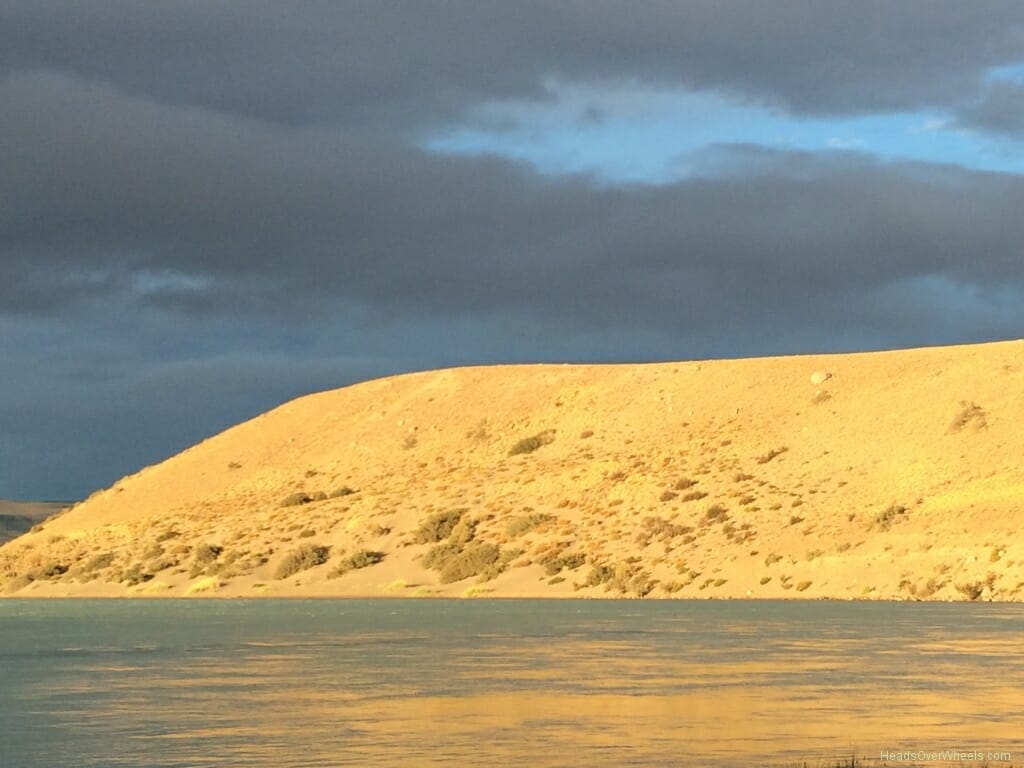
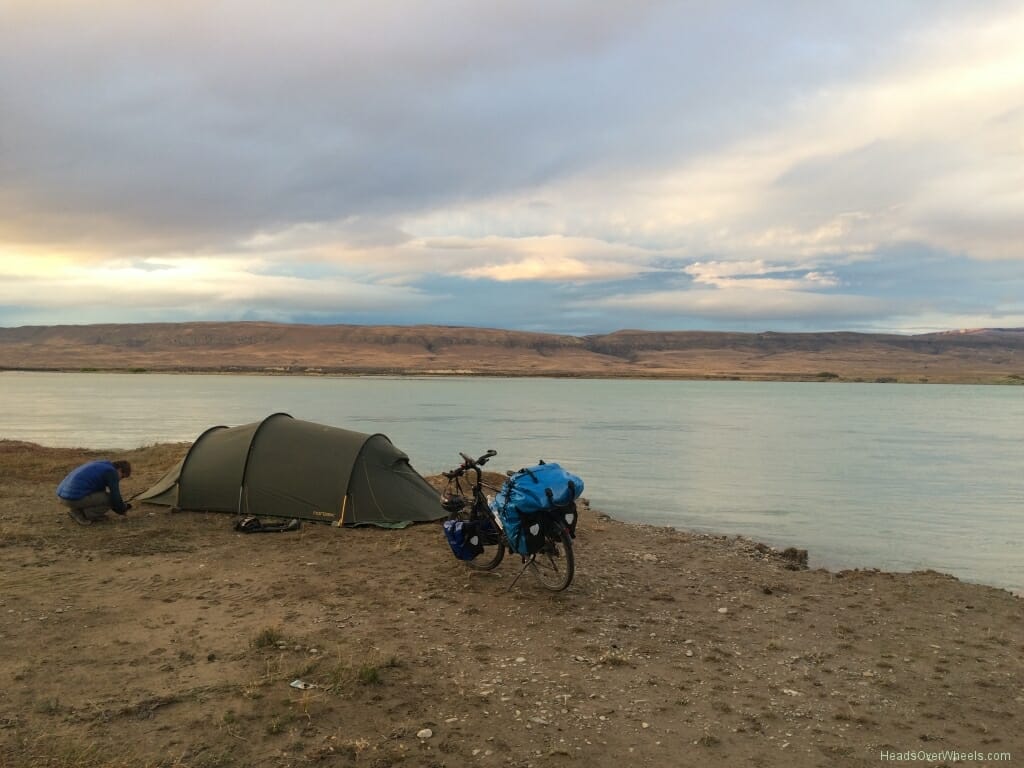 What can I say – God was kind to us and sent us a really great spot. Just when the day was nearing an end and we were losing hope to spend the night in a decent and safe place. The fence was here too but it was broken. There was enough space along the river and we wanted to set the tent up a bit farther from our neighbours, but the soil turned out to be very marshy there and the only solid ground was only closer to the bridge. So we had to set our camp up close to the men, hardly a meter from the water. The river was very beautiful, with milky green waters running very fast – as it happens in Patagonia, if you want to see rivers or lakes of unbelievable colours – it’s the place to be. When you are inside the tent, you hear the constant singing of the river, but this is not annoying – it’s soothing.
There was not a trace of the previous night’s gloominess in this place, it was light and lively, probably due to the fast flow of the river which made it feel like everything around was moving. The golden light of the evening sun lit the hills on the opposite side of the river. We felt like sitting and staring at this picture forever.
The night went quietly and when we woke up, one of our neighbours had left already, and the other was packing. We had a relaxed breakfast, packed and set off too, full of joyful anticipation. Yesterday we had made 65 kilometres, and we only had some 43 kilometres to go till El Calafate. We had no clue that this day would become the hardest of the three!
In the beginning we cycled some 10 kilometres, and they turned out to be not so easy as we wanted them to be, because again, just like yesterday, an ascent followed a descent. Too much exercise. Nevertheless we were moving at a decent speed. Soon we had to turn to route 11 – the final part of our journey. As we were progressing, we noticed that as soon as the road was turning west, we were running into a proper hurricane. Cycling was becoming a real struggle. I was quite worried by this discovery. I told Igor that route 11 was going to the west and that was what was in store for us – an endless fight with the crazy wind. Igor told me not to be such a pessimist. I answered that I was not a pessimist but a realist and I wanted to be morally prepared to what was ahead. We had a bit of an argument about this and I continued cycling separately from him, now fighting not only with the wind but with my own anger as well.
It turned out that my desire to be morally prepared was futile. Knowing what was ahead didn’t make me prepared in the least. For starters, we saw that route 11 was full of speeding cars and trucks. We could say goodbye to our relaxed cycling. Well – and there was wind. Hurricane like wind. As soon as we turned to route 11 it felt like we hit a wall. Cycling 100 metres in these conditions took efforts which to me seemed almost superhuman. If before I had cycled at 15-20 kilometres per our without a struggle, now I could only make 6 kilometres per hour only by the strain of all my powers.
We could actually see the wind. I think it was the first time in my life when I saw wind. Just like you can see streams of hot air going up from an asphalted road on a hot summer day, in the pampa you can see a stream of wind flowing over the ground. We had to fight this stream, remembering about the speeding cars with which we now had to share the road.
God, it was scary. I realized that instead of 3 hours which we had hoped to spend on the way to El Calafate, now we would have to spend at least 6. Six more hours of constant struggle and physical torture. If only the road were flat. No, on top of everything the freaking ruta 11 turned out to be a sinusoid – up and down, up and down…
Energy soon left me and I announced that I was not going anywhere – not before we had something to eat. On days like this you realize the role that food plays in your body in the way you have never thought about before. If in “normal” life one may seldom notice how having a meal creates a surge of energy, in a situation like this you feel, if I may say so, like a car, the engine of which is about to stall due to lack of fuel.
The question was how to start a fire. It was obvious that the wind would put off the fire in our camp stove and we needed a shelter, but what kind of shelter could there be in the steppe?
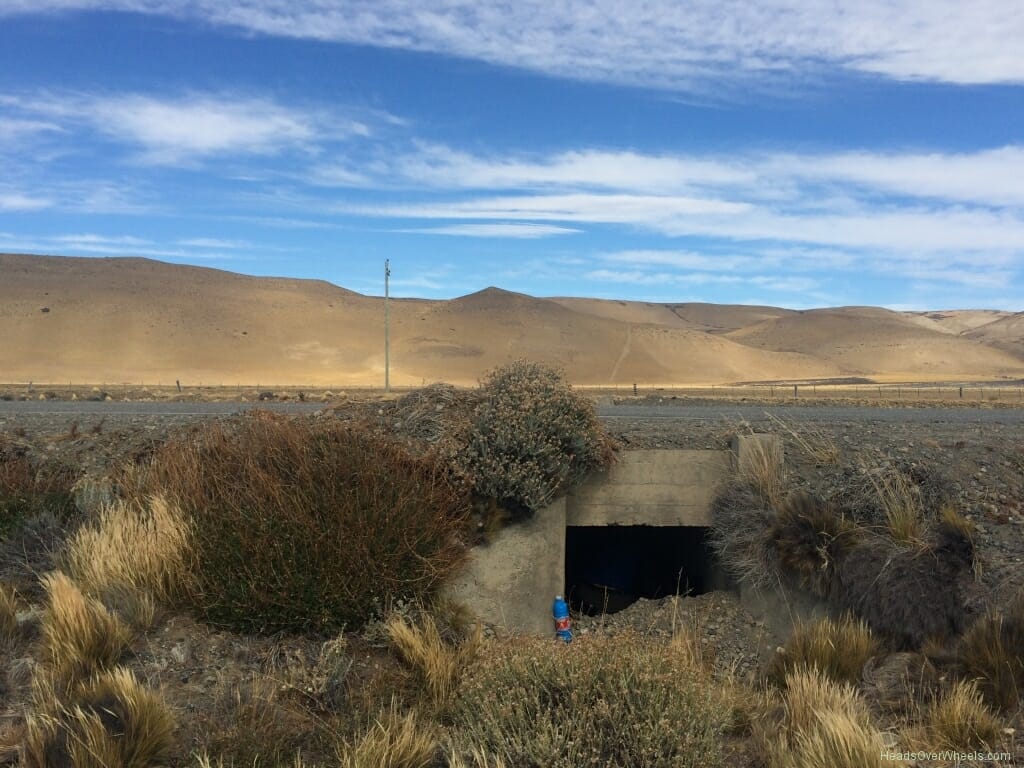
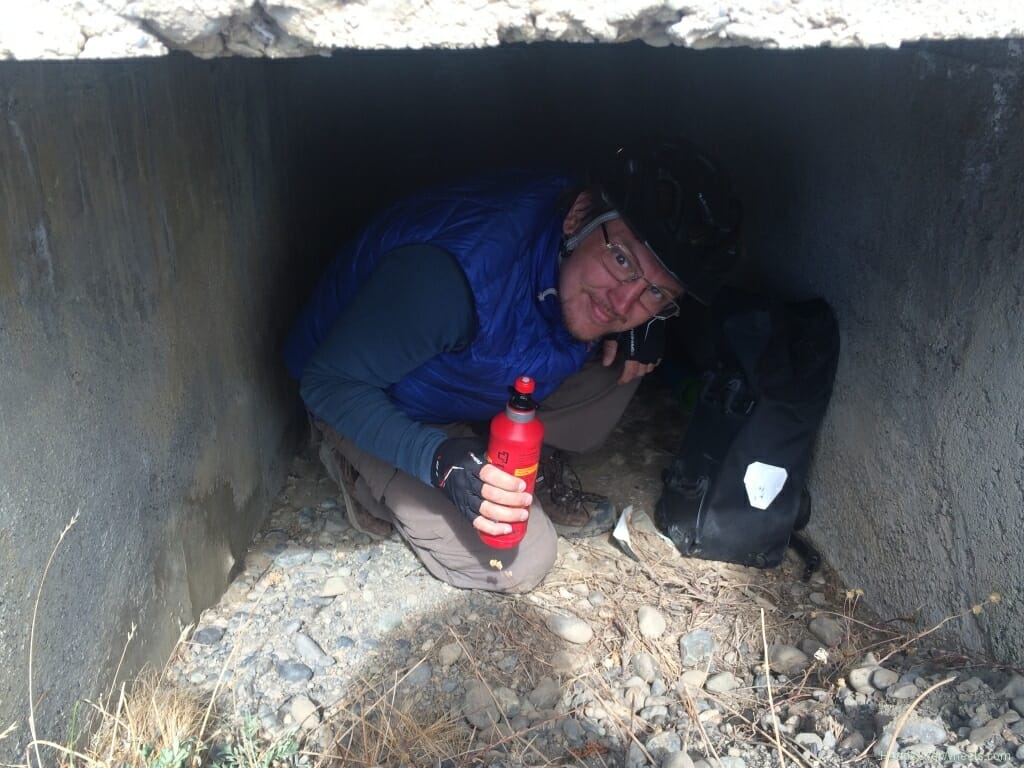 Surprisingly, we found an answer soon. Igor noticed that under the road there were small tunnels, you could enter them from both sides of the road. Igor suggested we stopped at one of such tunnels. The tunnels were small but a man could fit in there, even though one couldn’t stand up inside but it was possible to squat. Igor went inside the tunnel to cook and I waited outside the entrance where the wind was not felt as strongly as on the road.
We had very tasty pasta with tuna, drank some coffee and life started to feel much more acceptable. What seemed absolutely impossible, started to look a little less impossible. Maybe tremendously hard, but still doable. We continued the fight and slowly but surely were moving towards El Calafate. The biggest annoyance were cars that were not heard because of the wind, and they appeared out of the blue from behind us like jacks-in-the-box, startling us every time. The drivers apparently didn’t give a damn about our struggles and they didn’t bother increasing the distance so they flew by really closely. It was probably on that day that we finally realized and shaped the idea of what we really hated about bicycle trips and why we would never become the kind of dare-devil cyclists that are ready to use any kind of road with any kind of traffic including speeding cars and huge trucks. We just don’t like it when cars pass us by at a minimal distance at such a huge speed. We don’t fancy this kind of risk and we can’t find anything attractive in it or any kind of gratification except constantly being startled. Having said that we decided that in future, whenever we go on a cycling journey, we would be paying attention not only to the fact that a road from point A to point B exists, but also to what kind of road it is, which kinds of transport use it and how much of it there is.
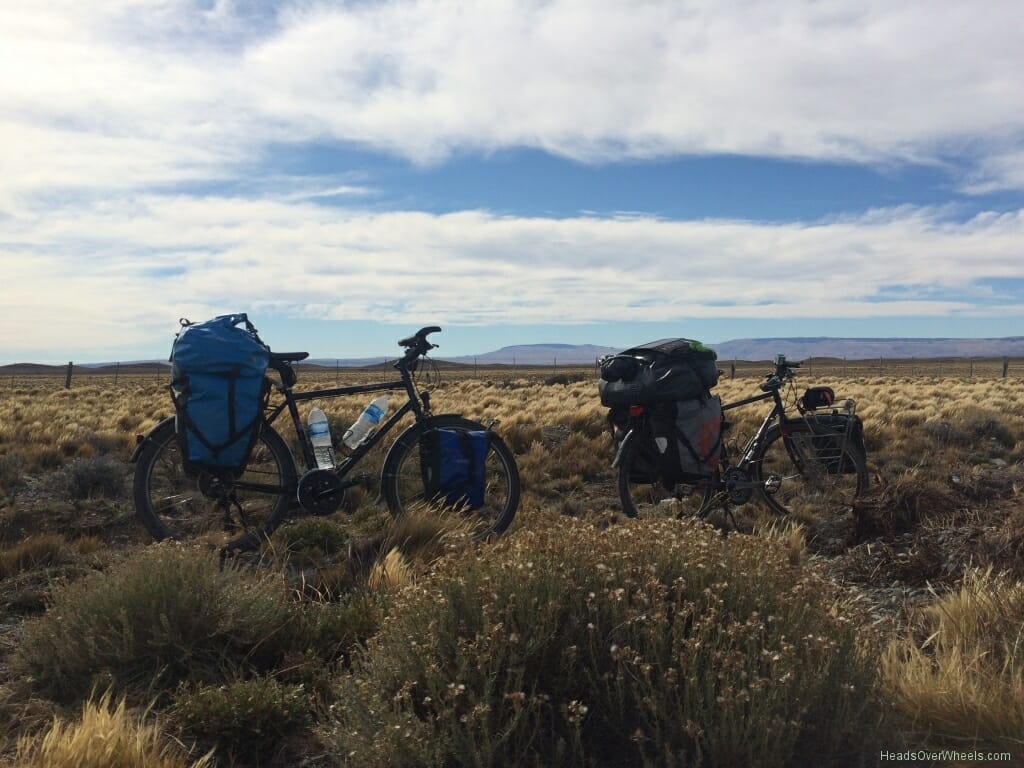 One way or another, we were approaching El Calafate. We were really close when energy left me again and I gave up. The next long ascent took the rest of my moral and physical powers, I had enough of the passing cars so I dismounted and started walking. Igor cycled ahead of me and waited for me on the top of the hill. I told him that I would walk till El Calafate no matter how much time it was going to take. Igor was exhausted too so he liked my suggestion, and we walked the remaining kilometres, only getting on the bikes when going downhill. Because there were much more ascents and they were very long, we mostly dragged the bikes.
That’s how we finished the last part of our trip – not like heroes, especially myself, but on our last legs.
Now I know for sure that some 100 kilometres are much better than some 30!
…It was cold in El Calafate. We cancelled our previous plan to go to a camping and went to a hostel instead where we had a room – a fantastic, cosy, warm room with a soft comfy bed. You can never appreciate simple conveniences as much as after spending a week in a tent!
There was only one small annoyance left: the feeling of numbness in my left hand which I started to have on the night we spent at Viedma lake, grew stronger. It was clear that it was not because of an uncomfortable sleep position but something else, as at the daytime my hand wouldn’t hold objects, and the little finer went completely numb. I couldn’t cross the index and the middle fingers. That was worrying, but thankfully we live in the time of the Internet so answers to many questions are literally at hand. I found out that this was a frequent problem for cyclists who cycled long distances. I can’t remember what the medical explanation was, but the reason that triggered it could be the wrong height of the seat or leaning on the handlebars too hard. I am not sure what caused my problem and it has to be solved if I ever want to cycle long distances again. My hand recovered in a couple of weeks so thankfully it was just a temporary annoyance.
To be continued – about challenging ourselves in Torres del Paine national park.